Residential Energy Use, 1973-1990

Earlier this week in Chicago I spoke to the Passive House Alliance, and for them I created a new talk entitled "Superinsulation and the History of the Solar House."  It was a full house and I really appreciated the attentive and intelligent audience.

I argued that passive solar heating and superinsulation are fundamentally intertwined, a theme which is probably somewhat sublimated in the book.  I based my argument on several key points:
1) In the first "solar house" in 1940, Fred Keck realized, just before construction, that he should quadruple the roof insulation
2) In several early solar houses (most notably Frank Lloyd Wright's 'solar hemicycle' for Herbert and Katherine Jacobs and Keck's Hugh Duncan house), the solar gains were 'defeated' by poor insulation and leaky construction
3) The understanding of thermal mass was crucial to the evolution of the passive solar house
4) By the 1970s, passive solar proponents such as Norman Saunders and William Shurcliff shifted their attention to superinsulation
5) When the Passivhaus movement originated in Germany, its founder (Wolfgang Feist) acknowledged that his ideas had been shaped by earlier examples in North America.  Therefore there is a historical continuity between solar house history and the current Passivhaus movement.

I also wanted to show that, when American homebuilders became relatively serious about both passive solar and superinsulation, after 1973, the effects were dramatic.  I included the following slide: 

Chicago energy slide.jpg

At the end of the talk, somebody (intelligently) asked about this statistic.  I sympathized with the question, because it does seem too good to be true.  Although I recalled this number being cited in Stewart Brand's book How Buildings Learn, I could not remember the original source.  I told the questioner that I would be happy to trace it and provide more information.

It turns out I made a mistake by omitting an important qualifier.  Here is Brand's statement:

"Between the Energy Crisis of 1973 and 1990, the money spent on space heating in new American buildings dropped by a dramatic 50 percent."

The word "new" was the critical omission.  But we still might wonder how the figure is normalized.  Brand's source was the article "Energy for Buildings and Homes" by Rick Bevington in Scientific American (September 1990).  Bevington's original statement is:

"Space-heating intensity, the amount of heat per unit floor area needed for a comfortable inside temperature, has dropped by almost 50 percent in new U. S. buildings. The decline has resulted from efficiency improvements spurred by the oil embargo of 1973."

I'll be sure to clarify this next time I make such a presentation! 

Anyway, I still find the statistic remarkable, and I'd like to find one for residential energy use in general in that period which would encompass passive solar, superinsulation, active solar, tight construction, more efficient furnaces, and President Carter asking citizens to turn down their thermostats and wear a sweater.  I have also read the following statement: "Since the 1970s, the amount of energy that Americans use for heating has fallen 40%. This is largely due to improvements in the efficiency of our mechanical systems as well as tighter, better insulated buildings." ("Why Weatherization isn't Enough")  But I haven't inquired about the source for that number.

In any case, the positive outcomes in the 1970s are a powerful reminder that Americans can make important changes when they are informed and motivated.


Update (February 2014)
Here's the new slide I use:

(The background image is from The Hawkweed Passive Solar House Book by Rodney Wright.)

Keck's Sloan house II: a new look

Editor's note: I did not mean the title to be misleading; obviously this is a new look at an old photo. A true new look isn't possible, as Sloan II was destroyed sometime circa 2010.

In The Solar House I call Fred Keck “The First Solar Architect.” Two full chapters of the book are devoted to his work.

I recently acquired a period photo of Fred Keck's second house for Howard Sloan, in the “Solar Park” neighborhood (Glenview, Illinois, 1942). It provides an excellent view of Keck's method for composing the south wall of his solar houses: large fixed panes of glass with exterior shading and ventilating louvers below. In the book I discuss the history of the ventilating louver, as well as placing Keck’s treatment of ‘the window’ in context of the ideas of other modern architects like Le Corbusier.

This photo was rarely published in articles of the period about Solar Park or Sloan's houses. (Here is one instance.) The photo comes from a newspaper archive liquidating its old stock. I’ve also included the news release attached to the back, which misidentifies the photo as being Keck’s Duncan house. The Duncan house was also a fascinating and seminal example, but this is clearly Sloan II.

Sloan II interior 01 sm.jpg
Sloan II interior 02 sm.jpg

On ventilating louvers, see also: Solar Principles and Laramie’s Hitchcock House

Reyner Banham on Solar Heating

In an earlier post, I briefly discussed Reyner Banham's importance and influence on me. See: Reyner Banham’s Unwarranted Apology

In 1977, Banham participated in an “Educators Roundtable” and offered some pointed remarks about building energy use and solar heating. As usual, these comments are insightful and original, reflective of both the times and enduring themes, and really funny:

 “I approve very strongly of energy conscious designall we consumers, who have to pay for the energy architects make us waste, approve it. I do not approve the energy-neurotic design attitudes that have turned much architectural teaching into a species of witch hunting of late, especially as this was merely over compensation for generations of energy-ignorant teaching going back to the Beaux-Arts.
I would rather entrust students to someone like Philip Johnson who frankly says that, ‘It is only air conditioning that makes my architecture tolerable,’ than to the kind of faculty-radical who fails any project that is not build of three-foot thick adobe and powered by chicken shit.

I would ask only that students be able to produce an approximate energy budget:
1) For day-to-day operation of their design at reasonable comfort levels.
2) For the original structural investment, including energy consumed in bringing materials to the site.
3) For 1) and 2) together over the probable life of the building (since this will often disqualify massive construction however fashionable at the time).
In general, I hope never again to find myself the only member of the jury who asks about solar heat gain, only to be told to shut up because historians aren't supposed to know about that kind of stuff!”

A few remarks. First, I hope we are now entering a time when historians are supposed to know about that kind of stuff! Second, in my experience, architecture students today are not able to do what he only asks in the second quotation (except for computer simulations), so I'm not sure we've come very far in 35+ years in terms of that particular intelligence.

And third, for all his lucidity and clarity here, Banham had an inconsistent or paradoxical side. As I mention in the book, he visited Steve Baer’s house, and wrote derisively of “Wood-burning Baer” and criticized the house’s technology as “far from radical ... individualistic, property-oriented, conservative and defensive.” And elsewhere I'm preparing a paper which will attempt to reconcile his futurist-mechanistic impulses (living in a perfectly-controlled polythene bubble) and his romantic admiration for Greene and Greene's Gamble house. (That paper is now available here.)

Sources:
“Educators Roundtable,” Journal of Architectural Education, February 1977.
“The Sage of Corrales,” New Society, 1983.

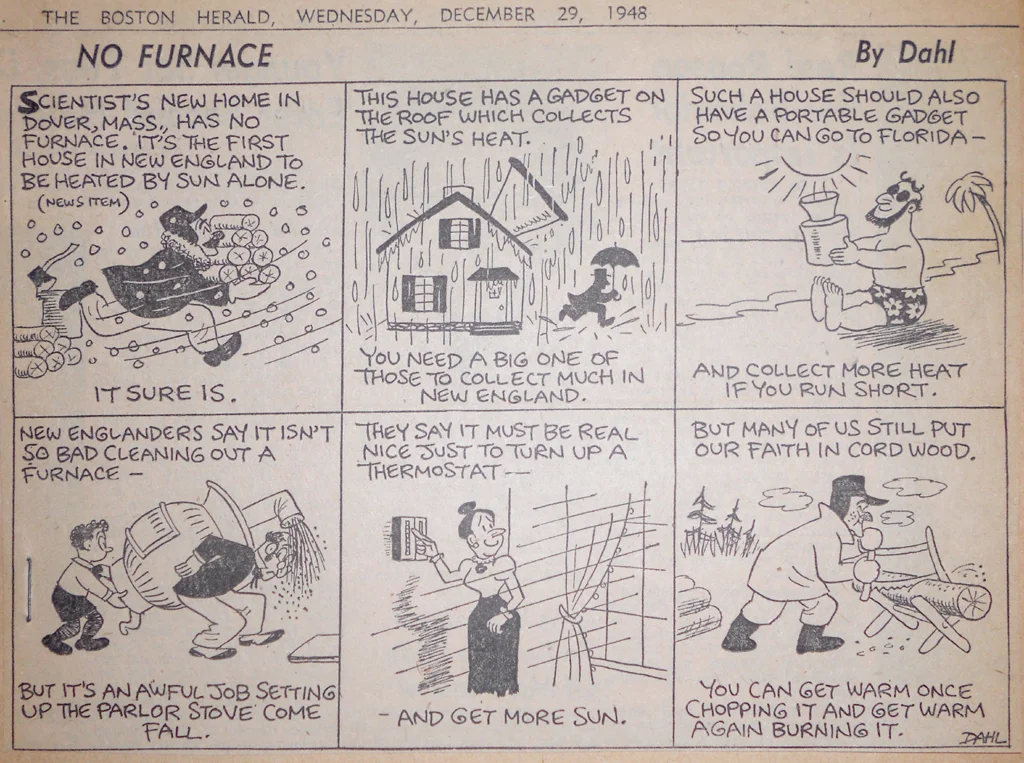
Unearthed: Dover Sun House comic

You always find unexpected and interesting things when browsing archival material.  Here's a comic from the Boston Herald in 1948 that was prompted by the Dover Sun House for Amelia Peabody by architect Eleanor Raymond and engineer Maria Telkes. 

Dover cartoon 02.jpg

(It's a poor photo but I did not try to manipulate the image too much.)

I don't have much to say about the content, although it clearly demonstrates that 'active' solar heating was received as a curiosity.  As I discuss in Chapter 6 of the book, the Dover Sun House was probably the most highly-publicized solar house before the 1973 energy crisis.

Maxwell Fry's Sun House

As I discuss in the book, the label "Solar House" was first used in 1940, by the Chicago Tribune, in a presentation of Fred Keck's Sloan house.  And the Sloan house was the first project (to my knowledge) where an architect calculated solar heat gain and compared it to the structure's heat losses in an effort to quantify energy savings.  Therefore the term "Solar House" is inextricably entwined with the science of solar heating and building energy use.

However, as I mention in the book's introduction and have expanded upon in this blog, there were a number of earlier architects interested in sun-responsive architecture but not solar heating per se.  Maxwell Fry's “Sun House” (London, 1935) is a remarkable example.

from Wikimedia Commons

from Wikimedia Commons

Fry did not specifically discuss the motivation for making a "Sun House," or the goals of the project.* Most likely, he was following the general influence of Le Corbusier in using the sun for aesthetic benefits.  (More on Le Corbusier soon.) 

There is no evidence that the Sun house was meant to use solar heat for energy savings.  Again I am taking pains to distinguish between sun-responsive architecture (including heliotherapeutic architecture) and solar-heated architecture.  In this sense, the Sun House is not a Solar House. 

The Royal Institute of British Architects published solar geometry diagrams in 1933 (first published in America in 1931), and the Sun House was planned "according to the RIBA diagrams," according to Daniel Barber.**  Fry did not use those diagrams to create shading for the windows in summer, and it is reasonable to assume the house overheated on occasion.  Since Fry practiced with Walter Gropius from 1934-36, it is clear that the Sun House was also related to Bauhaus studies in solar geometry exhibited at CIAM III in 1930.  (Whether Gropius contributed directly to the Sun House is not clear.)  In 1936, Fry and Gropius designed an ‘open air school’ for children with tuberculosis at Papworth, in Cambridge.  The project, with plenty of south-facing glass, was never built, but similar themes appeared in Gropius & Fry’s Impington Village College (Cambridge, 1939).

Nearly a decade later, in the book Fine Building of 1944, Fry wrote, for the first time, about solar heating:

Sunlight, not necessarily sunshine, is a form of heating that costs nothing.  If dwellings are planned so that the living quarters face the sun, which in England travels across the sky from east to west in a high curve in the summer and a low one in the winter, sunlight entering through generous-sized windows will heat throughout most days of the year, and the large windows will, on balance let in more heat than they let out.

By this date, the solar house movement was well-established in the United States, and the last phrase in particular betrays that Fry followed Keck's work in Chicago.  Still, Fry's late endorsement of solar heating should not be retroactively applied to the Sun house or his other work of the 30s.  There are no significant examples of solar-heated architecture in Great Britain before the mid-1950s.

In his later work, Fry focused on shading and natural cooling.  He collaborated with Le Corbusier on Chandigarh from 1950 to 1955, and with Jane Drew wrote Tropical Architecture in the Humid Zone (1956). 

 *The Architect's Journal, August 13, 1936.

**Daniel Barber, “Tomorrow’s House: Solar Energy and the Suburban Territorial Project, 1938-1947,” 2011 ACSA Proceedings