The Palm House at Kew Gardens

I recently visited The Palm House at Kew Gardens---an amazing experience and recommended to all.  I knew it to be a seminal building in the history of environmental controls due to its use of tinted glass, thanks to the work of my friend Henrik Schoenefeldt.*

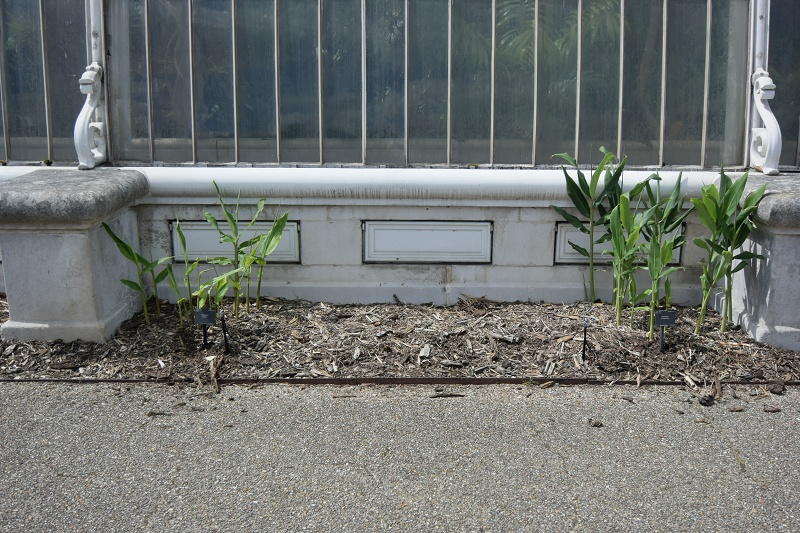
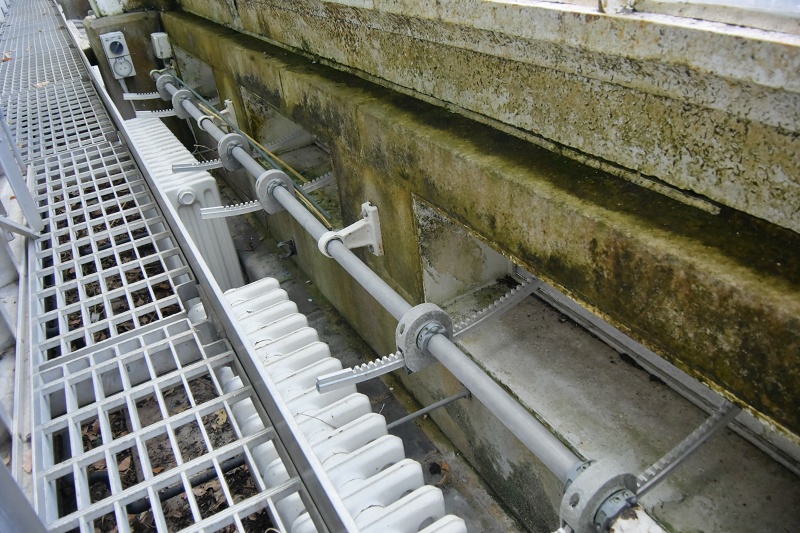
Behind the glass and wonderful iron structure, I found the Palm House to be highly sophisticated in its methods of heating and cooling.  The building has in-floor ducts, steam radiators in specially-designed wall cavities, and ventilating panels at the bottom of the wall!  These are clearly integral to the original building, completed in 1848.

In The Solar House I wrote about the use of ventilating louvers (which use the same type of tilting panels, behind louvers) in houses of the 1940s and 1950s**, but I was not aware that their origins were in Victorian England.  There is so much more work to be done in understanding the history of the well-tempered environment!

The first principle is clear: buildings with a lot of solar gain need a lot of ventilation.  It's remarkable to see that this principle was so well-understood so early. 

And a final note: Inside the Palm House is a catwalk structure which you can climb and walk among the treetops.  I'm guessing it's about 24 feet above the floor.  On the day I visited and climbed, the temperature difference was profound, probably on the order of 15°F higher up top---serious stratification!  I wish I had measured it.

*Schoenefeldt, Henrik. "The use of scientific experimentation in developing the glazing for the Palm House at Kew." Construction History (2011): 19-39.
**Also discussed a bit here: Solar Principles and Laramie's Hitchcock House and here: Keck's Sloan house II: a new look

A great Banham quotation

“…as architects edge temerously along the margin of the scientific disciplines and never quite put a foot over into the other camp…  It appears always possible that at any unpredictable moment the unorganized hordes of uncoordinated specialists could flood over into the architects’ preserves and, ignorant of the lore of the operation, create an Other Architecture by chance, as it were, out of apparent intelligence and the task of creating fit environments for human activities.”
—Reyner Banham, "Stocktaking" Architectural Review (February 1960)

And a note: “the lore of the operation” is not a toss-off line for Banham here. The meaning and importance of that concept is discussed at length in the article.

Previously:
Reyner Banham on Solar Heating
Reyner Banham's Unwarranted Apology

Solar Houses & Preservation: Lovable?

Almost none of the important examples in the history of the solar house survive in anything like original condition.  (Fred Keck's Sloan house, and Frank Lloyd Wright's Solar Hemicycle are the major exceptions.)  In part this may be due to the phenomenon of shearing layers, discussed in the previous post.  And in part this may be due to the fact that they were generally not designed to be lovable. 

In his book The Original Green, Stephen Mouzon argues that buildings must be lovable in order to be sustainable, because if they are not lovable they will not be preserved.  This page by Mouzon has a summary, or for the full discussion, buy the book.  Mouzon's idea built upon Stewart Brand's comment in How Buildings Learn that we need to understand "What makes some buildings come to be loved?”

In The Solar House, though I did not use the word lovable, I did discuss the fact that many landmark solar houses were designed as 'science projects' without much attention to architectural aesthetics.  Recently on the blog I extended this line of inquiry: The Saskatchewan Conservation House: Aesthetic Questions.

Of course "lovable" was not a general aim of 20th-century architecture.  And of course the term "lovable" has a conceptual problem a mile wide: it's purely subjective.  (Mouzon seems to be a traditionalist.)  More problematically for the Preservation disciplines, what is generally lovable changes with time.  You might want to preserve an unloved building because odds are it will be loved in the future.

Still, I think the concept of lovable, however slippery, does hold some value in assessing why experimental solar houses have such a poor track record of being preserved.  If more of those houses had been designed with more lovable features, would they have a better survival rate?  Or maybe we need to develop some more love for historic experiments.

Related: To Love a Building, a page by a student of mine (not about solar houses)

Loosely related: Loveabilty (with an e) is also discussed here.

Solar Houses & Preservation: Shearing Layers

I've been thinking quite a bit recently about intersections between issues of Historic Preservation and issues of Sustainability.  Of course this has been on my mind since the demolition of the George Löf house in 2013.  More recently, I taught a course (called Historic Preservation & Sustainability) where we looked at the potential for existing buildings to contribute to sustainability goals, and the challenges inherent in preserving/improving buildings from the Thermostat Age.

In the history of the solar house, there are a couple of fundamental issues with regard to preservation.  First is Stewart Brand's concept of shearing layers.  Brand's idea, which he discussed in the seminal How Buildings Learn, was that a building's different "layers" have different lifespans and therefore will be changed over time. 

Many of the seminal experimental solar houses were based upon mechanical systems (Services) which were experimental---no surprise.  Here's a great example of how shearing layers works in the history of the solar house: At Colorado State University (CSU), Crowther and Löf built a series of houses in the mid-1970s.  All had various active solar heating systems (panels or tubes) on their roofs.  Today, one of the houses exists, but its solar heating equipment has been removed.  The building still exists, but its integrity has been lost.

"Solar Village" house at Colorado State University by Richard Crowther, George Löf, et. al. (Fort Collins, 1974-75).  Photographed in 2011; equipment removed.


"Solar Village" house at Colorado State University by Richard Crowther, George Löf, et. al. (Fort Collins, 1974-75).  Photographed in 2011; equipment removed.

I'm given to understand that MIT Solar House IV also still exists in a similar state, without its original equipment.

Heating of Mies' IIT Chapel

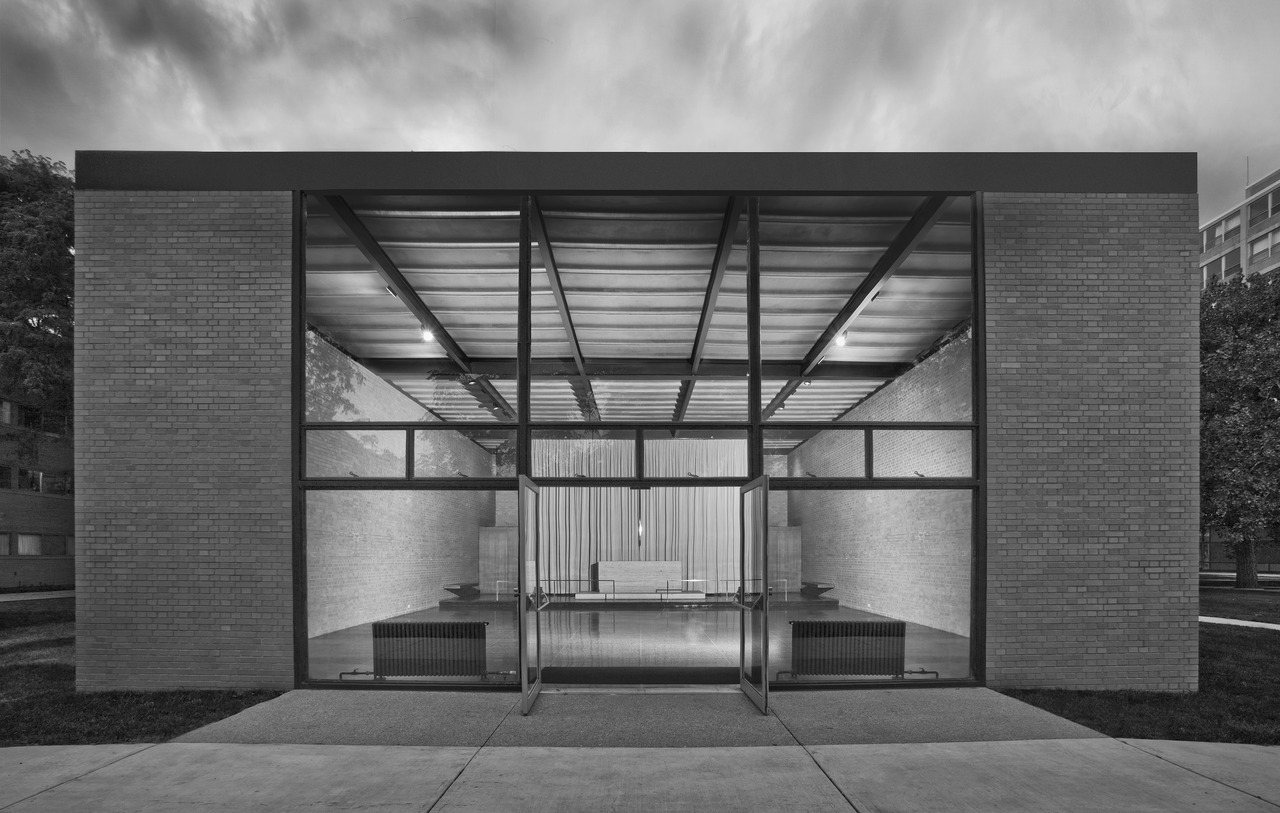
I recently visited the Chapel at the Illinois Institute of Technology (IIT), designed by Ludwig Mies van der Rohe and completed in 1952. It is officially called the Robert F. Carr Memorial Chapel of St. Savior. Fun fact: even though it is a non-denominational chapel, it was paid for by the Episcopal Diocese of Chicago.

The air in the Chapel is not heated. In fact, there is no mechanical air system at all. The Chapel was (and is) heated by a hydronic (hot-water) radiant floor system. The floor is terrazzo. One can imagine that Mies preferred this system because it is invisible, and he did not need to worry about how ducts and diffusers would need to interact with the ‘purity’ of the structure and the architecture.

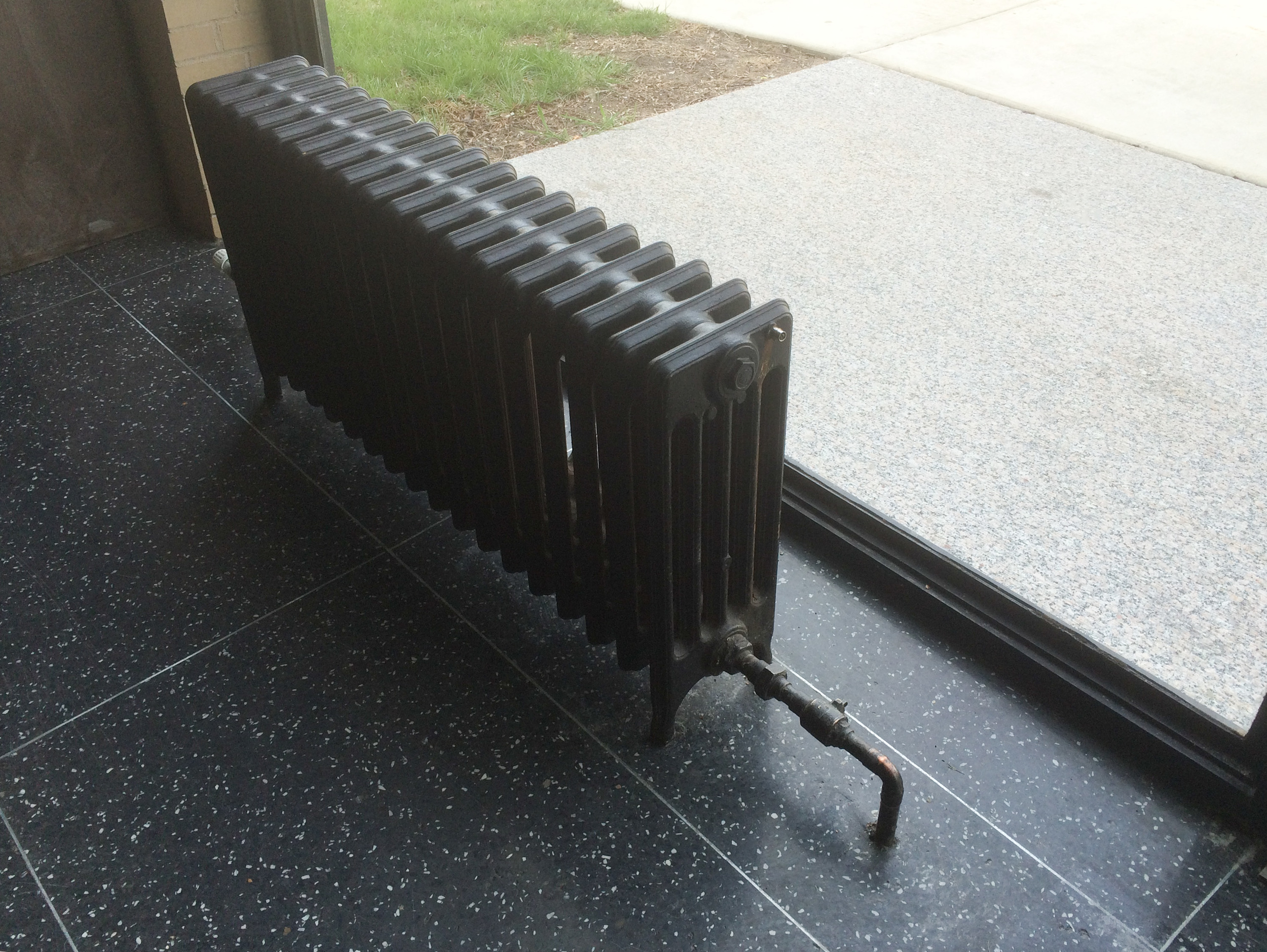
But there was one additional problem: the cold-glass effect. To compensate, there are also a couple of radiators inside the glass. It’s visually incongruent to see the Victorian method of radiator heating in such a quintessentially modern building. It must have been a painful compromise for Mies.

https://s-media-cache-ak0.pinimg.com/originals/5f/13/81/5f13817dc5132338df5c77a4860a05f3.jpg

https://s-media-cache-ak0.pinimg.com/originals/5f/13/81/5f13817dc5132338df5c77a4860a05f3.jpg

I am not sure how much insulation is (or was) in the brick walls, or the roof, or underneath the floor. Probably very little. Although the Chapel was restored in 2014 by Gunny Harboe the original mechanical systems weren't touched. As Blair Kamin noted, the chapel “can become an icebox during Chicago's brutally cold winters.” 

Also the chapel is oriented with the main glass facade to the east, and a secondary glass facade to the west. The entire south face is brick. Clearly Mies ignored the potential of passive solar heating. This may be considered a legacy of Zeilenbau orientation.

Also on the blog: Mies at IIT: “Greenhouses”
Related: Crown Hall restoration (Architecture Magazine)