

Thomas S. Hines (1936-2026)
/Thomas S. Hines, architectural historian and Professor Emeritus at UCLA, passed away in late July. He was my advisor and mentor, enormously influential and helpful to me. He was the ‘dean’ of California modern architecture, and I don’t think anybody has known the subject better. His accomplishments in teaching and research are staggering to consider—just looks at the books he wrote! His epic history of Los Angeles modern architecture, Architecture of the Sun, is 750 pages and rich with content.
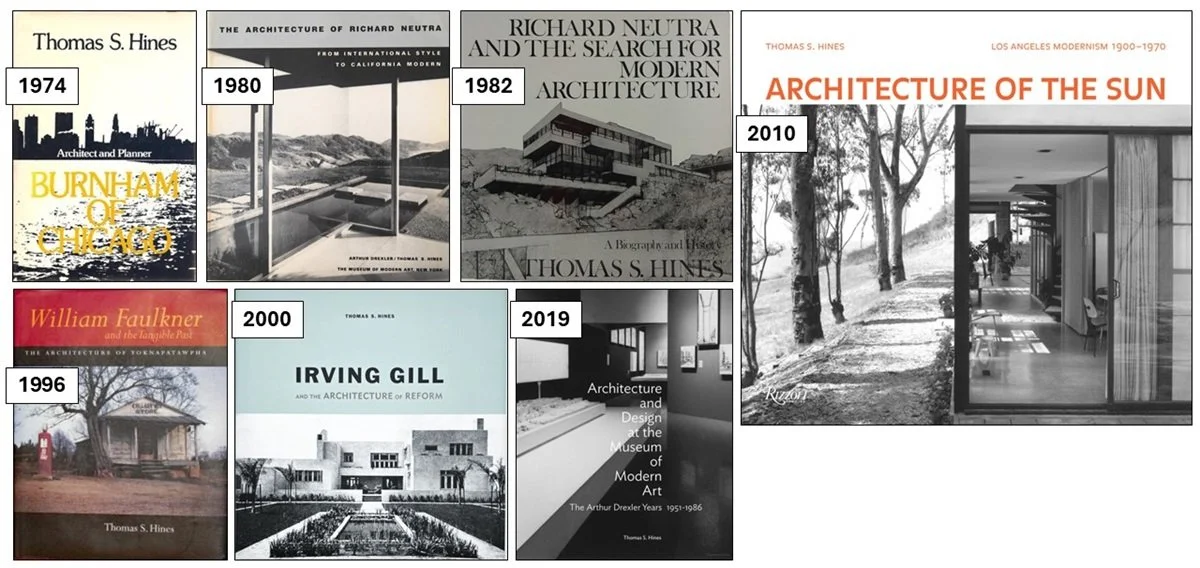
Tom earned his Ph.D. at the University of Wisconsin (Madison) in History in 1971; his original advisor was Irvin G. Wyllie. Wisconsin had one of the strongest History departments in the country at the time, in terms of American cultural history—Wylie wrote The Self-made Man in America: The Myth of Rags to Riches. Tom’s 700-page dissertation “Daniel Hudson Burnham: A Study in Cultural Leadership,” became the basis for his first book, Burnham of Chicago. He started at UCLA in 1968. I believe he was hired by Harvey Perloff, an urban planner, during a period when the School of Architecture and Urban Planning (SARUP) hired a number of faculty from outside architecture. He spent his whole career at UCLA. Despite being a southerner, raised in Oxford, Mississippi, he developed a great love for Los Angeles. He enjoyed giving tours.
Tom was an ‘old-school’ historian and professor, in the best sense. His research was thorough and he wrote in a clear, straight-ahead manner for a general audience. He did not engage in ‘theory’, as was the fashion in the 90s, although he appreciated good work of that type, such as Sylvia Lavin’s work on Neutra. I always say that clear writing depends on clear thinking, and I believe that Tom, like all great historians, was able to gather and organize tons or source material and then internalize it and distill it with great clarity. He was a great storyteller. And in an old-school way, he endorsed the canon and believed that history was created by great men.
Tom was an unapologetic modernist. He embodied this by living minimally in Neutra’s Kelton Apartments near UCLA and working, usually, at the Richard Meier-designed Getty Research Institute. Tom had little interest in Postmodernism or even eccentric strains of Modernism. In fact, he devoted about a decade to working on Richard Neutra when Postmodern architecture was at its height; in this sense, history was a critical project for him. It’s notable that Architecture of the Sun ended in 1970 and avoided the subject of Postmodernism, plus it called RM Schindler’s work “discordant” and John Lautner’s “flawed.” For Tom, modern architecture was a heroic struggle against retrograde forces: for example, he interpreted Irving Gill as fighting the Spanish revival.
Tom was jointly-appointed in Architecture and History at UCLA, and I think he should be remembered as a cultural historian who wrote about architects. For architects like Neutra and Gill, he wove biographical material and architectural projects into a seamless story. He relished in telling of colorful clients who challenged the architect; I think of Neutra and Josef von Sternberg, and of Gill and the progressive women of San Diego. To underline his priorities, in a review of David Gebhard’s Schindler, Tom wrote: “What the book lacks and cries for most is more material on Schindler's personality, his family, his associates, and his clients, in short, for a greater evocation of the social and cultural context of his life and work.”
It might not be well-known that Tom liked to write popular articles, usually for the magazine Architectural Digest. He told me that it was important to speak to wider audiences from time to time. He also appreciated their high-quality photography. I believe his last article for AD was in 2005, about Gary Cooper’s house by A. Quincy Jones.
The outlier in Tom’s oeuvre is William Faulkner and the Tangible Past, a book which is sweet, nostalgic, creative, and beautiful. It largely consists of passages from Faulkner’s literature juxtaposed with Hines’ photographs of Mississippi buildings. Often these are decaying Greek-revival plantation houses or vernacular structures. I’m not sure Tom was fully proud of this book, but he should have been. He seemed to treat it as something self-indulgent that he wouldn’t do again.
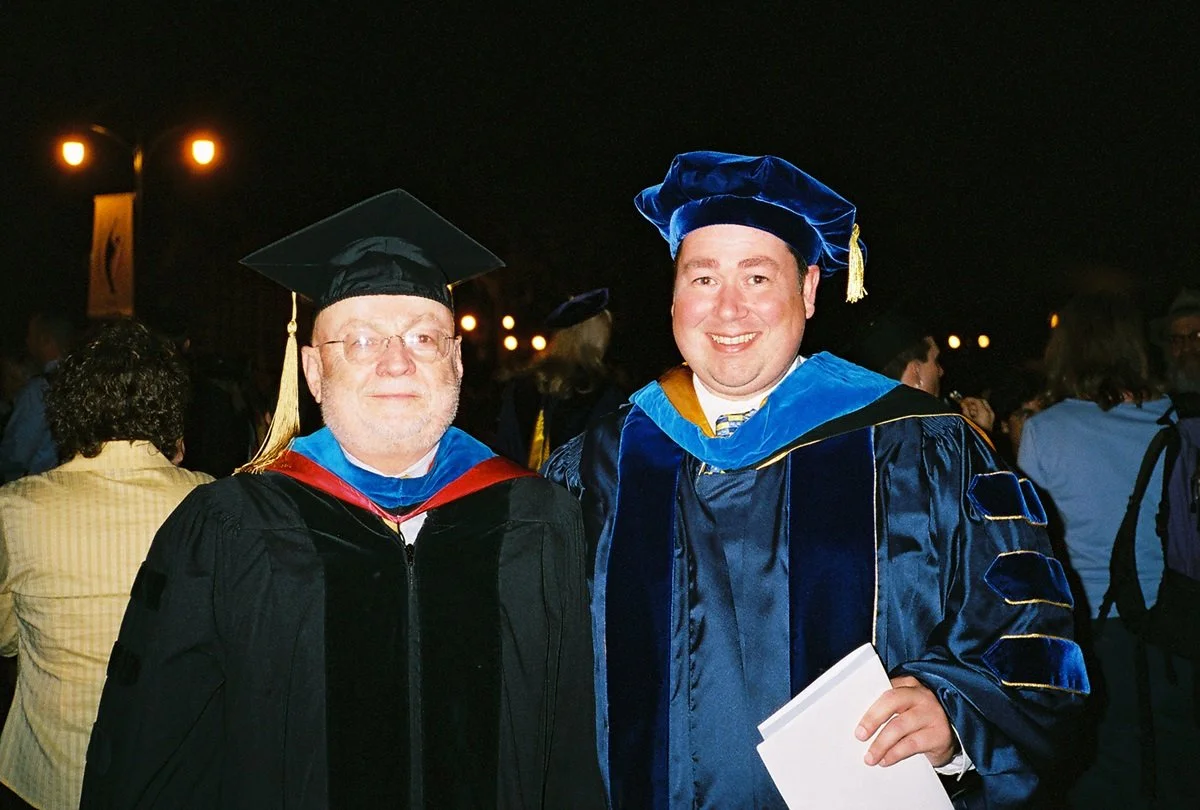
Tom Hines & Tony Denzer, 2005
When I applied to be a Ph.D. student at UCLA in 1998, I did so blindly—I did not know Tom or anyone else on the faculty—having chosen UCLA because I wanted to write about Irving Gill. I had studied Gill quite deeply as an M.Arch. student in Kansas and I thought Gill was the most innovative and interesting of California architects (and I still do). Tom hand-picked my application and said I could come, but I couldn’t work on Gill because he was writing the definitive book and it was nearly finished! I got over that disappointment pretty quickly—especially after seeing Tom’s great book—and I floated some other ideas. My proposal for an intellectual history connecting John Muir to Charles Keeler to RM Schindler to Frank Gehry did not hit the mark.
Tom suggested I look into some of the Mid-Century LA architects and after some investigation we agreed Gregory Ain would be a good fit. Ain’s social conscience appealed to me. It was given that my subject should be a person rather than a theme, I recall, a straight-ahead biography and monograph like his Neutra and Gill books. I got excited about Ain and spent about five years on that project. With my background in architecture, I aimed for deep readings of the building designs, and to do some graphic work of my own. Tom made sure that I visited the buildings and talked to homeowners. Later he advised that I should conceive the dissertation as a book and write for a general audience. In his old-school way, he marked up my drafts with the attention of a grammarian, no parentheticals allowed.
Tom was a supportive mentor, and I had all of his attention; he hadn’t had a Ph.D. student in many years. He insisted that I be a ‘generalist’ in architectural history as well as a ‘specialist’ in modernism, so in my exams I wrote about ancient and medieval architecture as well as Mies and Le Corbusier. He gave me the independence I sought, to work at an architectural firm and to teach some classes. I remember talking to Tom a few days after the events of September 11, 2001, and I was rattled, expecting that my focus should change in some way. He advised that such life-changing events should propel you to keep your focus and do good work. It was good advice!
When I finished my Ph.D. degree in 2005, Tom helped me immensely by sending my manuscript to David Morton at Rizzoli and pitching it. So getting my first book published was relatively easy. Tom also wrote a short and complimentary introduction. (Sadly, Rizzoli was not interested in a contribution by David Byrne, Ain enthusiast and homeowner, even though I asked him and he agreed.) Tom was enthusiastic about my job offer from the University of Wyoming, which surprised me because it’s small and it’s not Harvard, but he said land-grant, flagship, public universities have great advantages, and he was right about that, and I’m still here. Some years later when I told him I would be serving as Department Head, he was unable to hide his disappointment, because my ability to write books would suffer. Although I’m proud of my eleven years in that role, he was right about that too.
Thank you, Tom.
Thomas S. Hines bibliography
(surely incomplete)
Books
1974: Burnham of Chicago: Architect and Planner (Oxford University Press)
1980: The Architecture of Richard Neutra: From International Style to California Modern (Museum of Modern Art)
1982: Richard Neutra and the Search for Modern Architecture (Oxford University Press)
1996: William Faulkner and the Tangible Past: The Architecture of Yoknapatawpha (University of California Press)
2000: Irving Gill and the Architecture of Reform: A Study in Modernist Architectural Culture (Monacelli Press)
2010: Architecture of the Sun: Los Angeles Modernism, 1900–1970 (Rizzoli Publications)
2019: Architecture and Design at the Museum of Modern Art: The Arthur Drexler Years, 1951-1986 (Getty Research Institute)
Book Chapters and Articles
1967: “Frank Lloyd Wright: The Madison Years: Records versus Recollections,” The Wisconsin Magazine of History
1972: “Los Angeles, the Architecture of Four Ecologies, by Reyner Banham (book review),” Journal of the Society of Architectural Historians
1972: “The Imperial Façade: Daniel H. Burnham and American Architectural Planning in the Philippines,” Pacific Historical Review
1973: “American Modernism in the Philippines: The Forgotten Architecture of William E. Parsons,” Journal of the Society of Architectural Historians
1973: “The Paradox of ‘Progressive’ Architecture: Urban Planning and Public Building in Tom Johnson’s Cleveland,” American Quarterly
1976: “Two Traditions of American Planning: Olmsted and Burnham: A Review Article,” The Town Planning Review
1976: “Five California Architects; L. A. in the Thirties, 1931-1941; Schindler (book review),” Journal of the Society of Architectural Historians
1982: “Housing, Baseball, and Creeping Socialism: The Battle of Chavez Ravine, Los Angeles, 1949-1959,” Journal of Urban History
1988: “No Little Plans: The Achievement of Daniel Burnham,” Art Institute of Chicago Museum Studies
1988: “Heavy Metal: The Education of F. O. G.,” in The Architecture of Frank Gehry, Rizzoli
1990: “Nine and a Half Decades: The Achievement of Lewis Mumford (book review),” Reviews in American History
1992: contributor to Franklin D. Israel: Buildings + Projects, Rizzoli
1992: “Machines in the Garden: Notes Toward a History of Modernist Los Angeles Architecture,” Sex, Death and God in L.A., David Reid ed.
1994: “Then Not Yet Cage: The Los Angeles Years, 1912–1938,” in John Cage: Composed in America, Marjorie Perloff and Charles Junkerman eds.
1994: “Wilshire Boulevard: The Linear City, 1895–1945,” in The Grand American Avenue, 1850–1950, Jan Cigliano and Sarah Bradford Landau eds.
1995: “The Search for Frank Lloyd Wright: History, Biography, Autobiography,” Journal of the Society of Architectural Historians
2005: “Disciples and Masters: Schindler, Neutra, Wright,” in Frank Lloyd Wright: The Houses, Rizzoli
2008: “Introduction,” in Gregory Ain: The Modern Home as Social Commentary, Anthony Denzer, Rizzoli
2013: “Christa Wolf and the'Coming to Oneself': Reflections on a Friendship,” Getty Research Journal
2019: “Critic and Catalyst: Pauline Gibling Schindler (1893–1977),” Getty Research Journal
2021: “Picturing Modern Architecture: Photographer Willard Morgan and Richard Neutra’s Lovell House,” Getty Research Journal
Tom Hines Syllabi:
History of American Architecture survey
History of Los Angeles seminar
Tom Hines Videos:
Lecture on Arthur Drexler and MoMA’s Department of Architecture and Design (2019)
Inside the Eames House with Eames Demetrios, Thomas Hines, and Susan Macdonald
“Dodge Described” (short film by FORT-LA)
Links:
“Thomas S. Hines, Who Helped Put L.A. Architecture on the Map, Dies at 89” by Clay Risen
“Thomas Hines, scholar of modern architecture in California, dies at 89” by Edward Dimendberg
“Los Angeles–Based Architectural Historian and Educator Thomas Hines Dies at 89” by Russell Fortmeyer
“The man who changed how we see American modernism” by Paul Makovsky
“Remembering Thomas Hines, 1936-2026” (UCLA)
