
Public Housing and the ‘Thermal Ghetto’

In The Solar House I borrowed David Gissen's excellent concept of the ‘thermal ghetto’ to briefly discuss an issue in public housing that Fred Keck addressed beginning in 1950.  Gissen coined this term to discuss how low-income urban dwellers usually lack access to air-conditioning and disproportionately suffer heat-related deaths.*

Another type of ‘thermal ghetto’ is often produced in multifamily housing projects: when the building is extended east-west for proper orientation and a double-loaded corridor is used, half the residents are banished to a ‘thermal ghetto’ on the north, where they rarely see direct sunlight and the units are cold and dark, with high heating bills.  This was a common condition through the 20th century.  Keck wanted to avoid this type of ‘thermal ghetto’ when he designed the Prairie Avenue Courts, a superblock-type public housing project.  Keck wanted all of the the units to face south, so he needed to fight for a single-loaded corridor plan.  Keck developed a few solutions, the best of which is shown below.  In effect he treated the project like a large solar house (shading devices on the south façade are not shown). 

George Fred Keck Prairie Avenue Courts from Progressive Architecture, April 1951

George Fred Keck
Prairie Avenue Courts
from Progressive Architecture, April 1951

Keck's plan was clearly influenced by Le Corbusier's Pavillion Suisse; (see Le Corbusier and the Sun).

In the book I note that the 'outside corridors' were unfortunately enclosed in chain-link, and I quote Stanley Tigerman's colorful critique of that problem.  The project was demolished in 2002.

If you're interested in this subject, you'll also be interested in Zeilenbau orientation and Heliotropic housing.

*David Gissen, “Thermopolis: Conceptualizing Environmental Technologies in the Urban Sphere,” Journal of Architectural Education, 2006.


And here's an anecdote from England which shows that south-facing public housing can also become a 'thermal ghetto', in summer, if the design does not include shading (or air-conditioning).

The Ise Shrine in the age of solar heating

In my research I came across a number of solar-house-themed cartoons, which never failed to make me smirk or raise an eyebrow.   Here is the most memorable cartoon I encountered: the Ise Shrine, heated by a flat-plate solar-thermal collector.

Hozumi Kazuo "How would it be to draw off the water from the Isuzu River and utilize the heat from Amaterasu's sun? "  from Kenchiku Bunka (June 1963)

Hozumi Kazuo
"How would it be to draw off the water from the Isuzu River and utilize the heat from Amaterasu's sun? "
from Kenchiku Bunka (June 1963)

The specific context for the cartoon is a serious debate in Japan about tradition and modernity in the 1950s and 60s.  (The shrine is reconstructed every 20 years, and some of the earlier 20th-century reconstructions had not been perfectly authentic.  Kenzo Tange had suggested in 1959 that it was important for traditional monuments to be destroyed or desecrated sometimes.)

More broadly, the cartoon indicates how solar heating had become a global movement in the 1950s and 60s.  Chapter 9 of The Solar House looks at this theme.

And finally, the cartoonist unwittingly foreshadowed a policy question which is current today --- can historic buildings and landscapes tolerate solar equipment?  For more on the question, see Solar Today, Jan/Feb 2013 (advance to p. 46) and NREL's paper "Implementing Solar PV Projects on Historic Buildings and in Historic Districts" (pdf)

[The cartoon is used without permission from Jonathan M. Reynolds, "Ise Shrine and a Modernist Construction of Japanese Tradition," The Art Bulletin (June 2001). The Kenzo Tange information also comes from that excellent article.]


Lawrence B. Anderson on Air Conditioning

One of the important recurring themes in the history of the solar house, ironically, was the advent of air conditioning. In the book I discuss how the solar house and the all-glass house (requiring air conditioning) developed in parallel although they were fundamentally opposed in concept.

The architects who truly contributed to the solar house movement were modernists, and so most of them sought to control the indoor environment and embraced emerging science-based standards of comfort. But they were interested in saving energy, and so they were troubled by the increasing reliance on air conditioning. 

Lawrence B. Anderson is an important character in the book and one of those prescient critics of architecture's over-reliance on mechanical systems. Anderson was  the Head of Architecture at the Massachusetts Institute of Technology for decades at mid-century and designer of MIT's Solar House IV. In 1959 he wrote:

“Comfort is desirable; the mechanisms for achieving it threaten to strangle our art.

The honeymoon is over in air conditioning. A large surtax of dollars and space now penalizes almost every building project. We have come to rely on gadgets instead of using our brains to outwit the climate by shading, insulation, breezes, and other adaptations that used to give regional character. Much of our time is spent trying to balance budgets that are forty per cent mechanical equipment, and the rest of it goes toward figuring out where to put all the motors, fans, valves, ducts, transformers, filters, pumps, dampers, pipes, traps, vents, grilles, compressors, and access panels.

The brightest engineers got bored with environmental control before the architects. They regard these problems as having been solved years ago, and are now at work on rocketry. We are left with a great proliferation of devices that work some of the time, but no very sophisticated advice on how to arrange them for effective use.”

Our stereotype—mostly true—is that architecture in the 1950s paid little attention to proper envelope design and passive strategies while it fully embraced the advent of air conditioning. (See Gail Cooper's Air-Conditioning America for the larger story.) But a vocal minority of architects like Anderson swam against the powerful tide, and their resistance, in fact a form of social protest, should not be forgotten.

[Anderson quote from  "The Architect in the Next Fifty Years," Journal of Architectural Education, Spring 1959.]

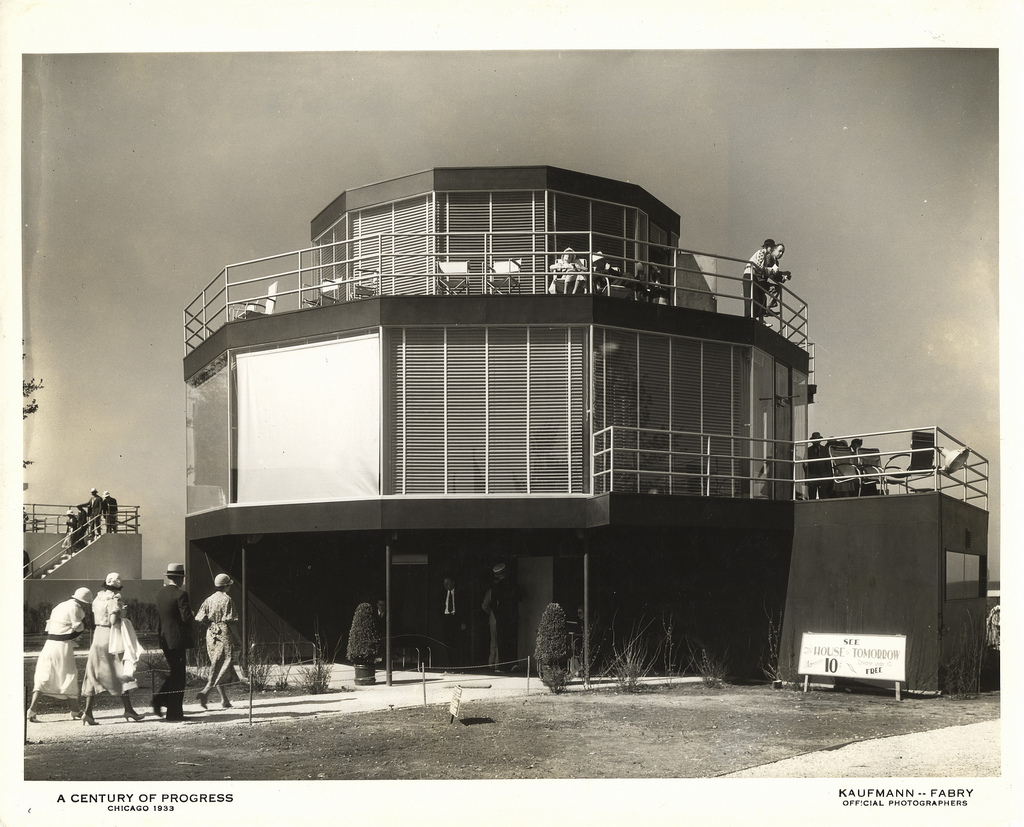
80 years: The House of Tomorrow

It was 80 years ago this month that construction began on Fred Keck's "House of Tomorrow" at Chicago's Century of Progress exposition.

House of Tomorrow by George Fred Keck (1933)​ Photo by Kaufmann & Fabry Co. from University of Illinois
at Chicago Library http://www.flickr.com/photos/uicdigital/4387523202/

House of Tomorrow by George Fred Keck (1933)​
Photo by Kaufmann & Fabry Co.
from University of Illinois at Chicago Library
http://www.flickr.com/photos/uicdigital/4387523202/

Keck said he 'discovered' solar heating when he found workers inside the house wearing only shirtsleeves on a frigid winter day. This is the legendary 'shirtsleeves story' which I deconstruct in the book. Still it is clear that the House of Tomorrow set Keck on a powerful, decade-long inquiry that culminated in the solar house movement of the 1940s.

My friend Jim Laukes, an independent scholar formerly of the National Center for Appropriate Technology (NCAT), wrote the following tribute:

 Well done and salutations on your 80th birthday, House of Tomorrow
 
Still holding out on a bluff overseeing the assaulting waves of a tumultuous inland sea, The House of Tomorrow, designed primarily by Chicago architect George Fred Keck for the 1933 Chicago Century of Progress Exposition has gained iconic stratospheres unanticipated at its inception.  Rare is the book on any aspect of American World’s Fairs which lacks a photo and mention of it.  
 
As a precipitously late entry into the Home and Industrial Arts group, it made an unusual fit. Neighboring Model Homes proclaimed sponsors such as aptly named Southern Cypress Manufacturers’ Association, American Lumberman’s Association, Brick Manufacturers Association, Masonite Corporation, Stransteel Corporation and the ‘breezy’ State of Florida which chose reinforced concrete as prime material. The glass and steel House of Tomorrow stood out on the proverbial limb, awaiting the huff and puff of a Neptunesque big bad wolf which might proverbially progress in blowhard destruction from straw to wood to brick. Recall that this grouping was only a few hog hollers east, and downwind, from the broad-shouldered stock yards. Steel-reinforced concrete stood as an obvious improvement, be it for wolves or hurricanes. (Straw was unrepresented in 1933 – see 1871 calamity - for fire safety reasons alone.) But those twelve sided expanses of single strength plate glass?  Hubris or prescience?  
 
Another exception awarded the House of Tomorrow was the commercial status of ‘concession’ – the ability to charge a 10 cent fee. Entry tickets to the Fair were 50 cents unless discounts applied and most exhibits were included.  A 1931 Century of Progress rulebook for the Model Homes in the Home and Industrial Arts group defined them as exhibits and admission fees were expressly forbidden.  Somehow this latecomer managed a ‘unique’ place on the Midway to Manna. More on this and related repercussions such as Chicago-style backroom business practices in a later writing.
 
If icons need heroic if not also tragic proportions, a saga of solar heating will perform nicely here. A story arose some years after the Fair closed that during a stage of construction, a few workmen had shed their winter coats while laboring inside the enclosed space. But the furnace was not yet operating. It's known as "the shirtsleeves story." This led Keck to begin speculation that the sun streaming bountifully through the glass was a readily available, cost-efficient source of space heating.  In many retellings, this took on a form akin to Isaac Newton’s gravitas apple. Sometimes the date of this accidental epiphany was set in February or less specifically after a freezing night.  With construction just getting underway in April, it’s likely that the glazing was not completed until very late in April or, more probably, in early May.  Two books,
The Solar Home: Pioneering Sustainable Design by Anthony Denzer (just published) and Let it Shine: The 6000 Year History of Solar Energy by John Perlin (available August 2013) elaborate on aspects of this tale.
 
As a self-proclaimed practitioner and student of Modernism, Keck’s model home should not be considered ahistorically. Estimable efforts by Mies van der Rohe such as the Barcelona Pavilion and the Tugendhat House deserve vital consideration.  As the paths of Mies and Keck would intersect at a later date, this must be pursued in further writings.
 
So, Happy Birthday, House of Tomorrow, and here’s a toast to a hundred more!

---Jim Laukes


And on the subject of Keck-related anniversaries, it's been 20 years since the last serious scholarly study of Keck's work: Robert Boyce's Keck & Keck: The Poetics of Comfort.  That's far too long for a figure of Keck's significance. 

More recently on the blog:
The House of Tomorrow Postcard
A National Treasure: The House of Tomorrow

Reyner Banham's Unwarranted Apology

0322030823.jpg

Architectural historian Reyner Banham has been a major influence on my work.  In particular, I consider his 1969 book The Architecture of the Well-Tempered Environment to be a monumental contribution to the discipline of architectural history.

Banham titled the introductory section of his book an "Unwarranted Apology." 

For what did he need to apologize?  The effects of the disciplinary divide between architecture and engineering—Sigfried Giedion's "schism."   Banham wrote:

"In a world more humanely disposed, and more conscious of where the prime human responsibilities of architects lie, the chapters that follow would need no apology, and probably would never need to be written.  It would have been apparent long ago that the art and business of creating buildings is not divisible into two intellectually separate parts—structures, on the one hand, and on the other mechanical services.  Even if industrial habit and contract law appear to impose such a division, it remains false."

The book then explored the immensely interesting story of how the development of architecture was shaped by mechanical systems of heating, ventilation, cooling, and lighting.  Although Banham had some grudging appreciation for pre-modern passive strategies, such as the shading of the Gamble house, the book is mainly a celebration of Victorian engineering and the evolution of modern environmental control. 

One of Banham's great contributions in The Architecture of the Well-Tempered Environment, is how he began to establish an aesthetic theory for the next paradigm (what we now call Green Building, I suppose).  Speaking of Zanuso’s Olivetti Factory, with its hollow concrete beams serving as air ducts, and its clip-on air-conditioners, Banham raved:

"The building is serviced, and manifestly seen to be serviced."

Banham borrowed this insight and its distinctive phrasing from himself.  Earlier, in describing the Glasgow School of Art and the Gamble house by Greene & Greene, he wrote:

"About the way the structure works, there is a … frankness, but it is made demonstrative: as with many modernists after him, so with Mackintosh, structure must not only be done, it must manifestly be seen to be done."*

For the time, this was a powerful idea, that a building's mechanical services ought to be exposed and coordinated with the overall aesthetic expression, perhaps even celebrated.  This was, of course, before the Centre Pompidou and Lloyd's of London.

Finally, and most importantly to me, Banham criticized fellow architectural historians for focusing on appearance and style, rather than the technical aspects of the building process.  He complained:

"However obvious it may appear, on the slightest reflection, that the history of architecture should cover the whole of the technological art of creating habitable environments, the fact remains that [it] still deals almost exclusively with the external forms of habitable volumes as revealed by the structures that enclose them."

For the most part, Banham's challenge has fallen on deaf ears.  (There are a few indications of change, which I'll plan to discuss on this blog in the future.)  And sadly, The Architecture of the Well-Tempered Environment is out of print and hard to find.  It should be required reading for architecture and engineering students.

●          ●          ●

*Banham, Guide to Modern Architecture (1962).  Banham borrowed the construction from the popular British saying: "Not only must Justice be done; it must also be seen to be done," which was written in law in 1923.

See also: Reyner Banham on Solar Heating