
Reyner Banham on Solar Heating

In an earlier post, I briefly discussed Reyner Banham's importance and influence on me. See: Reyner Banham’s Unwarranted Apology

In 1977, Banham participated in an “Educators Roundtable” and offered some pointed remarks about building energy use and solar heating. As usual, these comments are insightful and original, reflective of both the times and enduring themes, and really funny:

 “I approve very strongly of energy conscious designall we consumers, who have to pay for the energy architects make us waste, approve it. I do not approve the energy-neurotic design attitudes that have turned much architectural teaching into a species of witch hunting of late, especially as this was merely over compensation for generations of energy-ignorant teaching going back to the Beaux-Arts.
I would rather entrust students to someone like Philip Johnson who frankly says that, ‘It is only air conditioning that makes my architecture tolerable,’ than to the kind of faculty-radical who fails any project that is not build of three-foot thick adobe and powered by chicken shit.

I would ask only that students be able to produce an approximate energy budget:
1) For day-to-day operation of their design at reasonable comfort levels.
2) For the original structural investment, including energy consumed in bringing materials to the site.
3) For 1) and 2) together over the probable life of the building (since this will often disqualify massive construction however fashionable at the time).
In general, I hope never again to find myself the only member of the jury who asks about solar heat gain, only to be told to shut up because historians aren't supposed to know about that kind of stuff!”

A few remarks. First, I hope we are now entering a time when historians are supposed to know about that kind of stuff! Second, in my experience, architecture students today are not able to do what he only asks in the second quotation (except for computer simulations), so I'm not sure we've come very far in 35+ years in terms of that particular intelligence.

And third, for all his lucidity and clarity here, Banham had an inconsistent or paradoxical side. As I mention in the book, he visited Steve Baer’s house, and wrote derisively of “Wood-burning Baer” and criticized the house’s technology as “far from radical ... individualistic, property-oriented, conservative and defensive.” And elsewhere I'm preparing a paper which will attempt to reconcile his futurist-mechanistic impulses (living in a perfectly-controlled polythene bubble) and his romantic admiration for Greene and Greene's Gamble house. (That paper is now available here.)

Sources:
“Educators Roundtable,” Journal of Architectural Education, February 1977.
“The Sage of Corrales,” New Society, 1983.
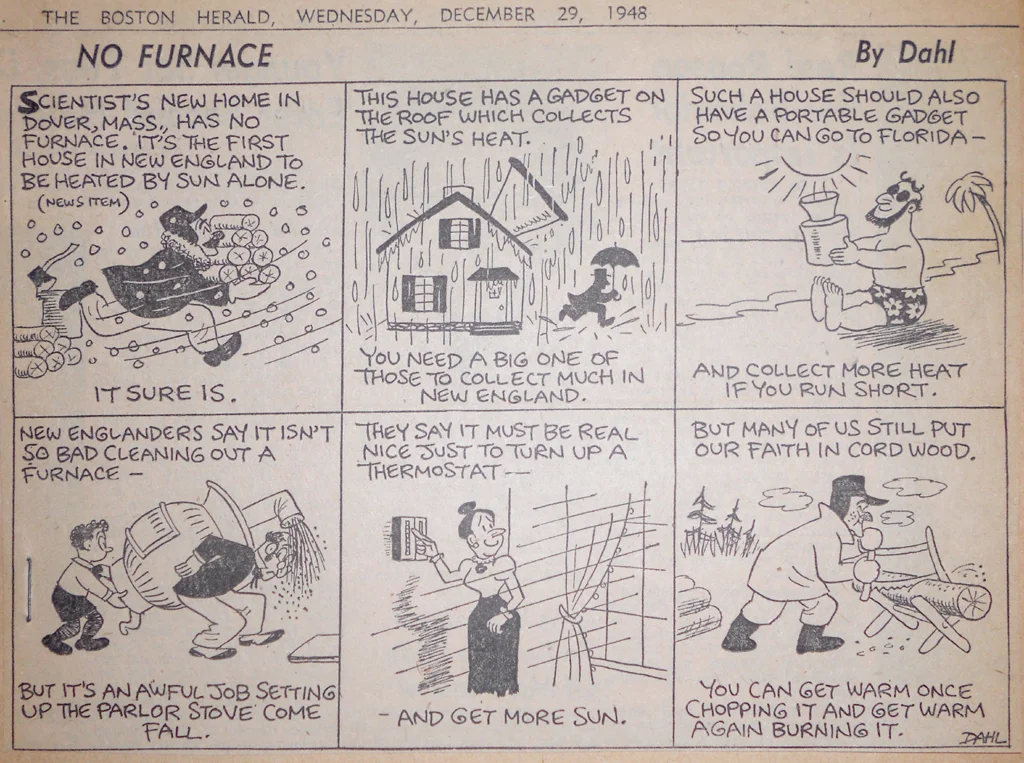
Unearthed: Dover Sun House comic

You always find unexpected and interesting things when browsing archival material.  Here's a comic from the Boston Herald in 1948 that was prompted by the Dover Sun House for Amelia Peabody by architect Eleanor Raymond and engineer Maria Telkes. 

Dover cartoon 02.jpg

(It's a poor photo but I did not try to manipulate the image too much.)

I don't have much to say about the content, although it clearly demonstrates that 'active' solar heating was received as a curiosity.  As I discuss in Chapter 6 of the book, the Dover Sun House was probably the most highly-publicized solar house before the 1973 energy crisis.

Maxwell Fry's Sun House

As I discuss in the book, the label "Solar House" was first used in 1940, by the Chicago Tribune, in a presentation of Fred Keck's Sloan house.  And the Sloan house was the first project (to my knowledge) where an architect calculated solar heat gain and compared it to the structure's heat losses in an effort to quantify energy savings.  Therefore the term "Solar House" is inextricably entwined with the science of solar heating and building energy use.

However, as I mention in the book's introduction and have expanded upon in this blog, there were a number of earlier architects interested in sun-responsive architecture but not solar heating per se.  Maxwell Fry's “Sun House” (London, 1935) is a remarkable example.

from Wikimedia Commons

from Wikimedia Commons

Fry did not specifically discuss the motivation for making a "Sun House," or the goals of the project.* Most likely, he was following the general influence of Le Corbusier in using the sun for aesthetic benefits.  (More on Le Corbusier soon.) 

There is no evidence that the Sun house was meant to use solar heat for energy savings.  Again I am taking pains to distinguish between sun-responsive architecture (including heliotherapeutic architecture) and solar-heated architecture.  In this sense, the Sun House is not a Solar House. 

The Royal Institute of British Architects published solar geometry diagrams in 1933 (first published in America in 1931), and the Sun House was planned "according to the RIBA diagrams," according to Daniel Barber.**  Fry did not use those diagrams to create shading for the windows in summer, and it is reasonable to assume the house overheated on occasion.  Since Fry practiced with Walter Gropius from 1934-36, it is clear that the Sun House was also related to Bauhaus studies in solar geometry exhibited at CIAM III in 1930.  (Whether Gropius contributed directly to the Sun House is not clear.)  In 1936, Fry and Gropius designed an ‘open air school’ for children with tuberculosis at Papworth, in Cambridge.  The project, with plenty of south-facing glass, was never built, but similar themes appeared in Gropius & Fry’s Impington Village College (Cambridge, 1939).

Nearly a decade later, in the book Fine Building of 1944, Fry wrote, for the first time, about solar heating:

Sunlight, not necessarily sunshine, is a form of heating that costs nothing.  If dwellings are planned so that the living quarters face the sun, which in England travels across the sky from east to west in a high curve in the summer and a low one in the winter, sunlight entering through generous-sized windows will heat throughout most days of the year, and the large windows will, on balance let in more heat than they let out.

By this date, the solar house movement was well-established in the United States, and the last phrase in particular betrays that Fry followed Keck's work in Chicago.  Still, Fry's late endorsement of solar heating should not be retroactively applied to the Sun house or his other work of the 30s.  There are no significant examples of solar-heated architecture in Great Britain before the mid-1950s.

In his later work, Fry focused on shading and natural cooling.  He collaborated with Le Corbusier on Chandigarh from 1950 to 1955, and with Jane Drew wrote Tropical Architecture in the Humid Zone (1956). 

 *The Architect's Journal, August 13, 1936.

**Daniel Barber, “Tomorrow’s House: Solar Energy and the Suburban Territorial Project, 1938-1947,” 2011 ACSA Proceedings

Tuberculosis and Solar Architecture (part 2)

As I mentioned earlier in Tuberculosis and Solar Architecture (part 1), I had written a chapter on sun-responsive architecture of the 1920s and 30s, but it needed to be cut from the book during editing for length.  Here's another excerpt.

I argue that the 20th-century solar house, defined by experimental attention to space heating and energy savings, occupies a different historical space than a strain of sun-responsive architecture in the 1920s and 30s which accommodated sunlight for reasons of health and hygiene (heliotherapy).  This genre, which may be known as heliotherapeutic architecture, emerged in concert with the sanatorium movement in late-19th century Europe, prompted by the idea that sunlight and fresh air contributed to a ‘cure’ for tuberculosis. 

Les Frênes (Leysin, Switzerland, 1911) was probably the first large purpose-built heliotherapy clinic to be constructed.  It featured south-facing rooms with terraces and large windows.  (These early sanatoriums are sometimes called the ‘Davos-type’, as that city was another center of activity.)  The director of Les Frênes, Dr. Auguste Rollier, published La Cure de Soleil in 1914 and L’Heliotherapie in 1923.  The latter became a best-selling book and may have influenced architects such as Le Corbusier. 

The sun played a central but underreported role in some canonical works of early modernism.  Tony Garnier’s Une Cité Industrielle (1901-17) project is well-known for its functional planning innovations and its aesthetic of repetitive concrete cubes, but it may also be interpreted as a “solar utopia.” 

Garnier’s plan included a centre d’héliothérapie, a long building consisting primarily of repetitive rooms with balconies and glass walls behind.  It became a strong influence for the sanatorium architecture that followed.  Garnier’s larger vision included houses that were “planned with equal solar access and … spaced to prevent shading of adjacent buildings during the winter months.”  Public buildings were also designed to receive direct sunlight “for sanitation.”

The most compelling early expression of heliotherapy in architecture is the Zonnestraal Tuberculosis Sanatorium by Johannes Duiker and Bernard Bijvoet (Hilversum, The Netherlands, 1925-31).  Zonnestraal, which translates as ‘sunbeam’, rendered the provision of sunlight and fresh air in the architectural language of high modernism, where literal and figurative cleanliness converged.  Duiker spoke of his architectural aspirations in terms of “spiritual economy.”  In Paul Overy’s view, “Light, air and openness could not have been more generously, or more spectacularly provided.”  This was roughly a decade before any architectural interest in solar space heating.


Zonnestraal Tuberculosis Sanatorium http://www.flickr.com/photos/tinamonumentalia/8963502157

Zonnestraal Tuberculosis Sanatorium
http://www.flickr.com/photos/tinamonumentalia/8963502157

Attention to heliotherapy prompted some designers towards integration of the architecture and engineering disciplines.  Zonnestraal’s award-winning restoration architect Wessel de Jonge has explained that Duiker and Bijvoet “preferred to coin themselves building engineers rather than designers, as proper knowledge of heating and cooling systems was decisive in designing light, open plan or even semi-open-air buildings for [the] climate.”  The concept of the architect as ‘building engineer’ also became significant theme in the history of the solar house. 

Duiker continued along this path of engineering innovation by using radiant ceiling panels in the Open Air School (Amsterdam, 1927-28), and patenting a hot-air system for the Gooiland Hotel (Hilversum, 1934).  It is striking to note that European architects conducted most of the exploratory work in heliotherapeutic architecture, while the solar house was principally an American phenomenon in its early experimental period.   

The deep sympathies between modern medicine, modern architecture, and the sun are further demonstrated by Alvar Aalto’s tuberculosis sanatorium at Paimio (1929-33).  The line of influence here is quite direct; Aalto had visited Zonnestraal in 1928.  

Paimio-Hospital-1978.jpg

Of course there are clear differences at every scale of analysis, particularly Paimio’s vertical emphasis and its smaller degree of transparency, both certainly motivated by considerations of the site or climate.  But the broader effort is consistent: to create architectural meaning from a need to provide sunlight, fresh air, and cleanliness for the patients’ recuperation.  The design solution at Paimio may be regarded as even more comprehensive than the Dutch example due to Aalto’s custom-designed furniture and fixtures. 

But again Paimio, like Zonnestraal, did not specifically seek to deliver solar heating or to save energy.

Also on the blog: Alvar Aalto and Solar Geometry

Selected Sources:
Richard Hobday, The Light Revolution: Health Architecture and the Sun, 2006.
Paul Overy, Light, Air and Openness: Modern Architecture Between the Wars, 2007.
Wessel de Jonge, “Zonnestraal: Restoration of a Transitory Architecture: Concept, Planning and Realisation in the Context of its Authenticity,” DOCOMOMO Proceedings, 2003.
Margaretha Ehrström, et. al., eds., “Nomination of Paimio Hospital for Inclusion in the World Heritage List,” 2005.


"Freak Houses Mounted on Turn-tables"

In my research for the book, I came across this curious bit of criticism from Canadian scientist E.A. Allcut from 1945:

"The direct use of solar heat may be extended somewhat, with good results, in specially designed buildings, but it is unlikely that freak houses mounted on turn-tables and operating as rotating solaria will be of immediate importance.  Even if large numbers of these special buildings were constructed, there would still remain the problem of heating the enormously greater number of houses that are already in existence."
(“A Fuel Policy for Canada,” The Canadian Journal of Economics and Political Science, February 1945)

This argument struck me because I couldn't think of ANY freak houses mounted on turn-tables in the solar house movement.  The solar house was a popular concept in 1945, and its basic definition was not freakish: large areas of glass facing south with proper shading.  Non-rotating solar houses were frequently featured in popular magazines and architecture journals.  Most were quite normal-looking.

I finally decided Allcut must have been thinking of the Villa Girasole, a historical oddity with practically no precedent, built near Verona, Italy, in 1929-35.  This large L-shaped building could rotate on a massive turntable-like base.

The Villa Girasole was the creation of Angelo Invernizzi, a civil engineer who worked for the rail service.  Hence it used a mechanism of railroad wheels, tracks, and gears.  Lewis, Tsurmaki, and Lewis concluded that it “destabilizes and inverts the assumed fixed relationship between building and site.…  an irrational project of rational objectives.”  (Lewis.Tsurumaki.Lewis: Opportunistic Architecture, Princeton Architectural Press, 2008)

Because Invernizzi named his house Girasole (sunflower), it can certainly be located within the larger category of sun-responsive architecture.  One might assume that that the building would face the sun as it moved across the sky.  But, as Chad Randl has noted, the family occupied the house in summer only, and consequently it was usually turned away from the sun.  (Chad Randl, Revolving Architecture: A History of Buildings that Rotate, Swivel, and Pivot, Princeton Architectural Press, 2008)  Period photos also show heavy exterior window coverings. 

There is no evidence that solar heating played any role in its conception, and it was never touted as a "solar house."

More:
2010 Film: Il Girasole. A House Near Verona (available from University of Chicago Press)
2008 Oliver van Poucke article at Kinetic Architecture (with many images)
2008 Lloyd Alter column at Treehugger

More recent Blog entry:
More thoughts on the Villa Girasole

●          ●          ●


The other major revolving structure of this period was the "Solarium Tournant," built in Aix-les-Bains in 1930 by Dr. Jean Saidman as a clinic for tuberculosis and rickets.  The upper platform moved to follow the path of the sun throughout the day.  With the appearance being a cross between a Dutch windmill and an early flying machine, the structure was perhaps even more 'freakish' than the Villa Girasole.

If Allcut  directed his remark to this structure, he was being deliberately obtuse, since this building had almost nothing in common with the "solar house" as it was understood in the mid 1940s.

More on the Solarium Tournant: http://jlggb.net/blog2/?p=5072 

●          ●          ●


Another rotating house not discussed in the book: La Maison Tournante, by François Massau (Wavre, Belgium, 1958) --- too late to be the object of Allcut's remark.

I find roof especially interesting, but I am at a loss to determine a scientific or environmental reason for its eccentric shape.

Information about this project is scant, but it seems Massau's wife was ill and she needed sunlight and heat for her health. This would again place the building in the genre of sun-responsive architecture, or more accurately heliotherapeutic architecture in the tradition of the tuberculosis sanatorium.  It does not appear to have been an experiment in solar heating for fuel savings.

Massau was in the coal business; neither an architect or engineer.  Apparently he built three rotating houses and they all remain working.

More: New York Times

●          ●          ●


Finally, in her 2005 article "What Tuberculosis did for Modernism" (Medical History), Margaret Campbell briefly discussed the phenomenon of Revolving Summer Houses, which were popular among the Dutch and elsewhere in Northern Europe in the early 20th century.  These were typically small, one-room structures built for therapeutic purposes.  Again, they were never part of the future trajectory of solar-heated architecture, and could not have been on Allcut's mind when he made his curious remark.

Revolving summer house (1925) in Edinburgh. From "What Tuberculosis did for Modernism" by Margaret Campbell (Medical History, 2005).

Revolving summer house (1925) in Edinburgh. From "What Tuberculosis did for Modernism" by Margaret Campbell (Medical History, 2005).