Hoyt Hottel's skepticism

Would you be surprised to learn that one of the most significant figures in the history of the solar house was never terribly excited about the prospects for solar heating? I'm referring to MIT engineering professor Hoyt Hottel, who designed and built the first-ever ‘active’ solar house, in 1939. In the book I call him a “skeptical innovator.”

http://webmuseum.mit.edu/browser.php?m=people&kv=10073&i=12284

http://webmuseum.mit.edu/browser.php?m=people&kv=10073&i=12284

Hottel's MIT Solar House I was a tremendous engineering success, using flat-plate hot-water collectors of his design. It produced as much heat as it needed on an annual basis. A year later, in 1940, he gave an extraordinary speech at Harvard. He complained that other scientists compared the amount of solar energy on an acre of land to a “healthy stream” of oil from a garden hose. He exclaimed: “solar power is not just there for the taking!”  A long excerpt from that witty speech is included in The Solar House (pages 101-102).

Here are a few more skeptical tidbits from Hottel which aren't included in the book:

“When we started we had high enthusiasm.  But we slowly came to realize that while there were uses of the sun, they were not as promising as we all thought they would be.” (1976)

“If you wish to lose the least money, get fifty percent of your heat from the sun.  If you wish to lose no money, don't get any.” (1976)

Here Hottel is reacting to the times; by the mid-1970s there was considerable public enthusiasm for the solar house concept, but an inexperienced industry to fill the need. 

Hottel’s campaign of restraint culminated in his article “Cloudy Forecast” in Skeptic magazine (Mar-Apr 1977), where he argued that the government shouldn't subsidize “presently available ideas that are economically shaky” but that they should look for “better ideas.” One might note that the predominant ‘presently available idea’ for solar house heating at that time was Hottel’s own: flat-plate collectors with water storage. He also predicted that solar’s future would depend upon principles which “remain to be discovered.” (And he didn't mean photovoltaics.)

I think a lot of creative people (like the subject of my earlier book, architect Gregory Ain) end up doubting the value of their work in retrospect, especially near the ends of their lives. Hottel was different: he didn’t necessarily doubt the importance of his own solar house experiments, but he (seemingly) wanted to prove—from the 1940s to the 1970s—that the active solar house wasn’t economically feasible at the time. He clearly took pride in his role as a skeptic, and believed he was making a contribution by broadcasting caution.

In the 1978 article “Tinkering with Sunshine,” Tracy Kidder wrote:

A consultant from Arthur D. Little would tell me later, “Hottel hasn't heard of the oil embargo.” A prominent inventor of passive systems would say, “Hottel's a man who bought a ticket on a horse and threw it away before the race was over. Now he can't bear to think that his horse might come in.” Hottel, for his part, has said that solar-heating enthusiasts base their case on emotion, not on natural law.

I wonder if any other figure in history had such strong record of innovation and impact in a field that they didn't necessarily believe would succeed.

(Note that Daniel Behrman also discussed Hottel’s “latter-day role as a Cassandra” in his 1976 book Solar Energy: The Awakening Science.)

Zeilenbau orientation and Heliotropic housing

Note: I later expanded on this subject in the paper: “Modern Architecture and Theories of Solar Orientation” for the 2014 ASES National Solar Conference.

● ● ●

John Perlin's new book Let It Shine: The 6,000-Year Story of Solar Energy is an impressive work and a rewarding read. It includes a very interesting section about German solar architecture of the 1920s and the well-known Zeilenbau (row-house) plans for public housing.

In Perlin's text I was struck by the presence of the phrase 'heliotropic housing', which he attributed to John Robert Mullin, who used it in a 1977 article.1 Heliotropic means 'sun-responsive', or perhaps more accurately 'solar-oriented'. What Perlin did not mention is that 'Heliotropic housing' actually comes from Catherine Bauer's seminal book Modern Housing (1934), where she used the term as a section-heading for a short discussion of this same subject.

Bauer (later known as Catherine Bauer Wurster) said it was considered a "rule" in German housing that "every dwelling must face in two opposite directions."  She also wrote:

"[The] scientific optimum for Frankfurt's geographical position was a row-direction of north-north-west to south-south-east.  The living-rooms and kitchens are then put on the west side and the bedrooms and bathrooms, in so far as possible, on the east."

Major examples of Zeilenbau projects oriented with the long axis north-south, so that the units face east-west, include:

  • Weissenhofseidlung by Ludwig Mies van der Rohe and others (Stuttgart, 1927).

  • Wohnstadt Carl Legien by Bruno Taut and Franz Hillinger (Berlin, 1928-30).

  • Siedlung Westhausen by Ernst May (Frankfurt, 1929-31).

  • Großsiedlung Siemenstadt by Martin Wagner, with Hans Scharoun, Walter Gropius, Hugo Häring and others (Berlin, 1929-34).

  • Siedlung Dammerstock by Walter Gropius and others (Karlsruhe, 1929).

  • Hellerhof Seidlung by Mart Stam (Frankfurt, 1929-32).

Of course the actual 'scientific optimum' for passive solar heating would be an east-west row-direction, so that the long side of the building faces south, where the winter sun is strongest.

Zeilenbau orientation, as exemplified by Dammerstock housing scheme by Walter Gropius (1927-28) From: http://www.detail.de/architektur/themen/vom-sanatorium-zum-zeilenbau-000193.html

Zeilenbau orientation, as exemplified by Dammerstock housing scheme by Walter Gropius (1927-28)
From: http://www.detail.de/architektur/themen/vom-sanatorium-zum-zeilenbau-000193.html

Zeilenbau orientation was the subject of controversy at the time, as Perlin mentions.  In Modern Housing, Catherine Bauer said "recent studies by Mr. Henry Wright" contradicted the German practice.  (Whether she referred to the father or the son, Henry N. Wright, is unclear.  I have not been able to find any studies by Wright conducted as early as 1934, so there's a future discovery to be made.)  Later in the extraordinary chapter on "Solar Heating" in Tomorrow's House (1945), Henry N. Wright outlined the critique of Zeilenbau orientation:

"It was in the Germany of the Weimar Republic that modern buildings were put up in the greatest quantities and frequently in the most interesting forms.  The architects of this period, which included most of the 1920's, had a theory about their glass buildings which they proceeded to put into effect.  The theory sounded very good.  It was that a long building, running north and south, would have its longest sides exposed to the east and west.  This meant, according to the theory. that the east rooms would get sun all morning and the west rooms would get sun all afternoon.

Once built, the structures themselves punched the theory full of holes. In the first place, the cost of heating these buildings was excessive. In the second place, the cheerful morning sun varied with the seasons. In midsummer there was plenty of sunlight coming in from the east, while in midwinter, when the sun rose far to the south, there was only a short time in which these rooms received the dubious benefits of their western exposure. In the third place, people living in the west rooms found that for most of the year this exposure was practically intolerable. The interiors were blistered in summer by the late afternoon sun, and the strong light coming in at a very low angle was unpleasant and hard to screen out with shades."

The full text of Tomorrow's House is linked from the Resources page.  Henry N. Wright was a major figure in the story of the solar house, and there is quite a bit more about him in the book.

Finally, Perlin asks: "How did these renowned architects err so badly?"  He concludes that they simply did not understand the science.

In my view, the Zeilenbau orientation requires a bit more exploration.  I would start by noting that European modern architects of the 1920s, conditioned by the sanatorium tradition, were generally concerned with licht and sonnschein rather than sonnenenergie.  (In fact, I would like to know when the phrase sonnenenergie, solarwärme or solarheizung first appeared in the German architectural discourse.  Probably in the 1940s or 50s.)  I figure that architects like Ernst May concluded that bedrooms needed direct sun in the mornings because heliotherapeutic considerations---health and hygiene---were stronger than energy use in the 20s.  

Some additional context on this matter is provided by the manifesto of Swedish modern architecture: acceptera, written by art historian Gregor Paulsson, with architects Gunnar Asplund, Wolter Gahn, Sven Markelius, Eskil Sundahl, Uno Åhrén, and published in 1931.  acceptera (tiden) meant "Accept the Times."  As may be expected, the Swedish approach is perfectly clear in its logic:

"...the demand that all modern dwellings get direct sunlight has endowed modern housing areas with a completely new character. It has necessitated an open style of building, with parallel blocks whose orientation is determined with reference to the sun, [long axis] east-west if there are through-apartments, otherwise north-south. The first building type is preferred as it permits cross-ventilation and provides a side that is genuinely sunny. But it requires through-apartments which, reducing the depth of the building, lead to longer facades as well as fewer apartments on each stairwell, such that this system is economically inferior to blocks that run from north to south."2

The east-west-facing orientation of the Zeilenbau, and the fact that it was (mistakenly) touted as a 'scientific optimum', probably explains why Le Corbusier oriented the Unité d’Habitation buildings to face east-west beginning in the late 40s. Even though the science was better-understood by that time, especially in America, I suppose Le Corbusier to some extent fell back on his memory of standard German practice.

Perlin also emphasized Hannes Meyer's interest in passive solar heating, of which I was not aware.  Meyer, according to Perlin, thought of the building as "a solar accumulator" and wanted to "obtain maximum exposure."  Meyer's position seems to blur the bright line I have sought to draw between sun-responsive architecture and solar-heated architecture.  Meyer worked with the Swiss Meteorological Institute, presumably to understand solar geometry better, or maybe even to try to estimate solar heat gains.  He does not seem to have spoken of energy savings.


1Mullin, "City Planning in Frankfurt, Germany, 1925-1932: A Study in Practical Utopianism," Journal of Urban History , Nov. 1977.

2acceptera was translated and reprinted in Modern Swedish Design: Three Founding Texts, MoMA, 2008.

Keck's Solar Park today

When I visited Chicago for some book events last month, I scheduled an extra day to re-visit Solar Park, a neighborhood in Glenview which Fred Keck designed for developer Howard Sloan in 1939-42.  (Fred Keck was "the first Solar architect," in the modern sense, as I discuss in great detail in the book.)  My friend Jim Laukes was my traveling companion and many thanks to him for a memorable adventure.  We also visited a solar neighborhood by Keck in Glencoe.  More on that soon.

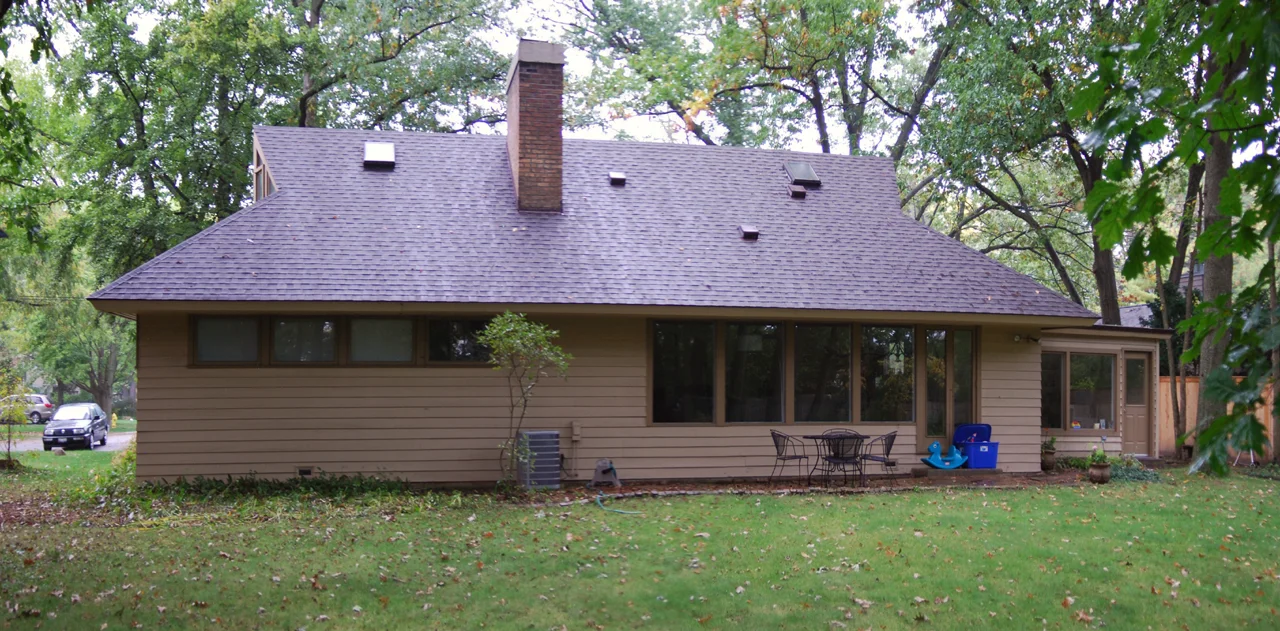
First, the good news.  The first Sloan house (1940), for which Sloan coined the label "Solar House," is in beautiful and original condition.  I did not photograph the characteristic south wall because it faces a private backyard, but it remains just like the Hedrich-Blessing photo included in the book (p.15), with the uplifted roofs of the clerestory and the screen porch wonderfully intact.  The north side, pictured here, faces the street.  You can just detect a portion of the uplifted roof to the left of the chimney.

Fred Keck, Sloan house  (1940). Photo © Anthony Denzer, 2013.

Fred Keck, Sloan house  (1940). Photo © Anthony Denzer, 2013.

The bad news?  Sloan II is gone, destroyed a few years ago.  Many others are lost as well.  In fact, there is only one other original Keck in this immediate neighborhood.  Sloan named one of the short streets in his subdivision "Solar Lane," and the name remains, but today there are no solar houses remaining on Solar Lane:

Photo © Anthony Denzer, 2013.

Photo © Anthony Denzer, 2013.

The 'McMansion' phenomena has certainly taken its toll on solar house history---see the George Löf house---and of course there have been many such tragedies in the wider world of historically-significant Midcentury Modern houses.

About a mile away, we found Paul Schweikher's Redwood Village Cooperative (aka North Shore Cooperative) semi-intact.  Four of the original seven houses are clearly recognizable, if somewhat altered.  This one corresponds to the Hedrich-Blessing image at the bottom of p.17 of the book:

Paul Schweikher, Redwood Village Cooperative  (1942). Photo © Anthony Denzer, 2013.

Paul Schweikher, Redwood Village Cooperative  (1942). Photo © Anthony Denzer, 2013.

The redwood siding has been painted.  A room has been added at the right.  But more significantly, the character-defining ventilating louvers have been removed from their location below the four tall windows.  I imagine they disappeared at the same time a new feature (seen at the center) arrived---the air conditioner.

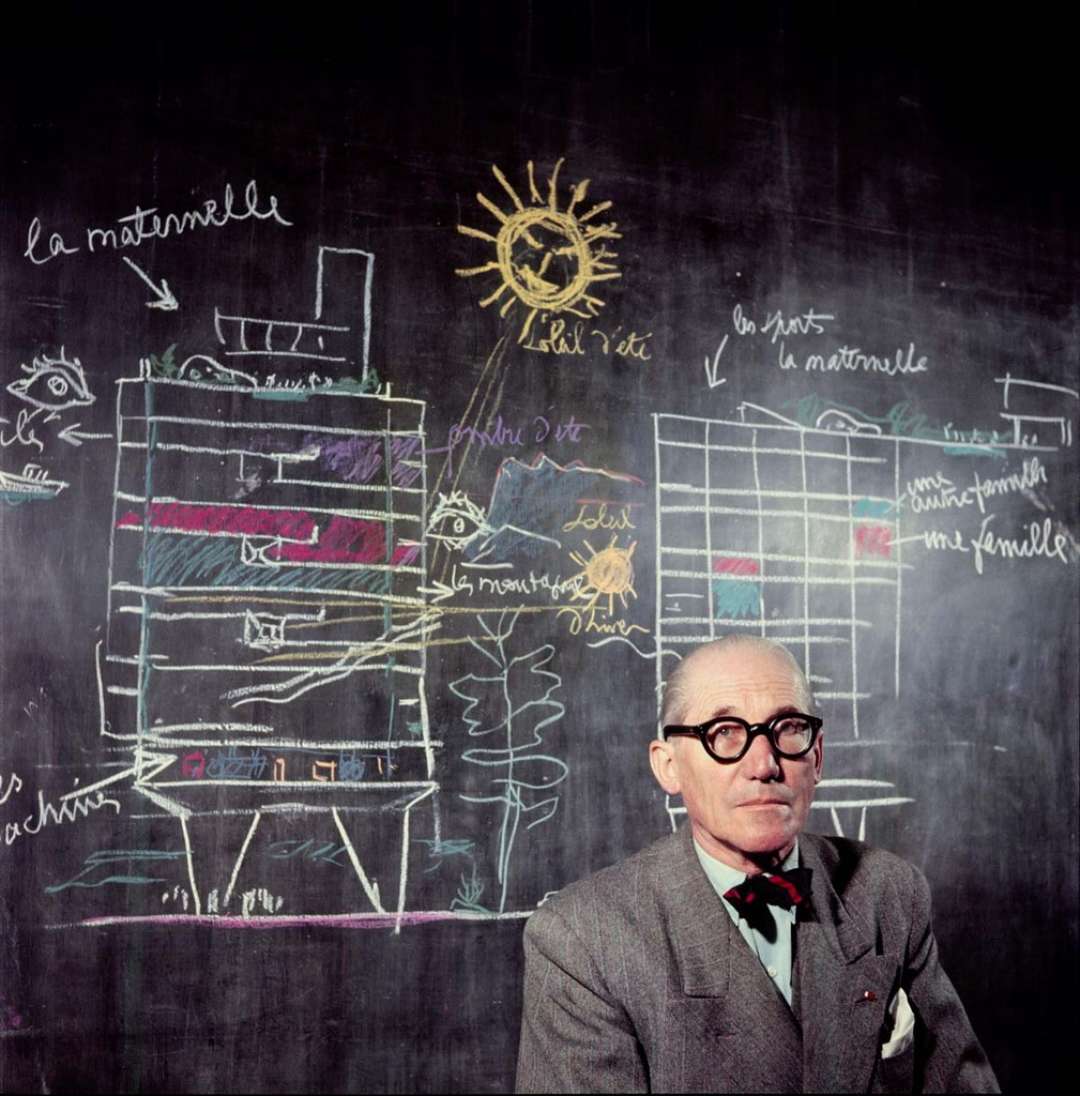
Le Corbusier and the Sun

from https://acdn.architizer.com/

from https://acdn.architizer.com/

“To introduce the sun is the new and most imperative duty of the architect.”
                                                                 —Le Corbusier in The Athens Charter

Le Corbusier is not discussed at length in my book The Solar House, because he did not design a ‘solar house’ by its strict definition—he was not interested in using the sun to save heating energy.  But in the related category of sun-responsive (or heliotherapeutic) architecture, he stands among the major figures.

Le Corbusier's interpretation of sun-responsive architecture took on powerful mytho-poetic dimensions.  For starters, every attentive architecture student notices the inscription “Soleil” on the aerial sketch of the Villa Savoye (Poissy, 1929), and learns that the grand promenade through the house reaches its monumental conclusion at the solarium.  I tend to agree with Richard Hobday’s claim:

“That the Villa Savoye is a temple to sunbathing is beyond question.

(Incidentally, the Villa Savoye was oriented diagonally to the cardinal points, as was Palladio's Villa Rotonda.)

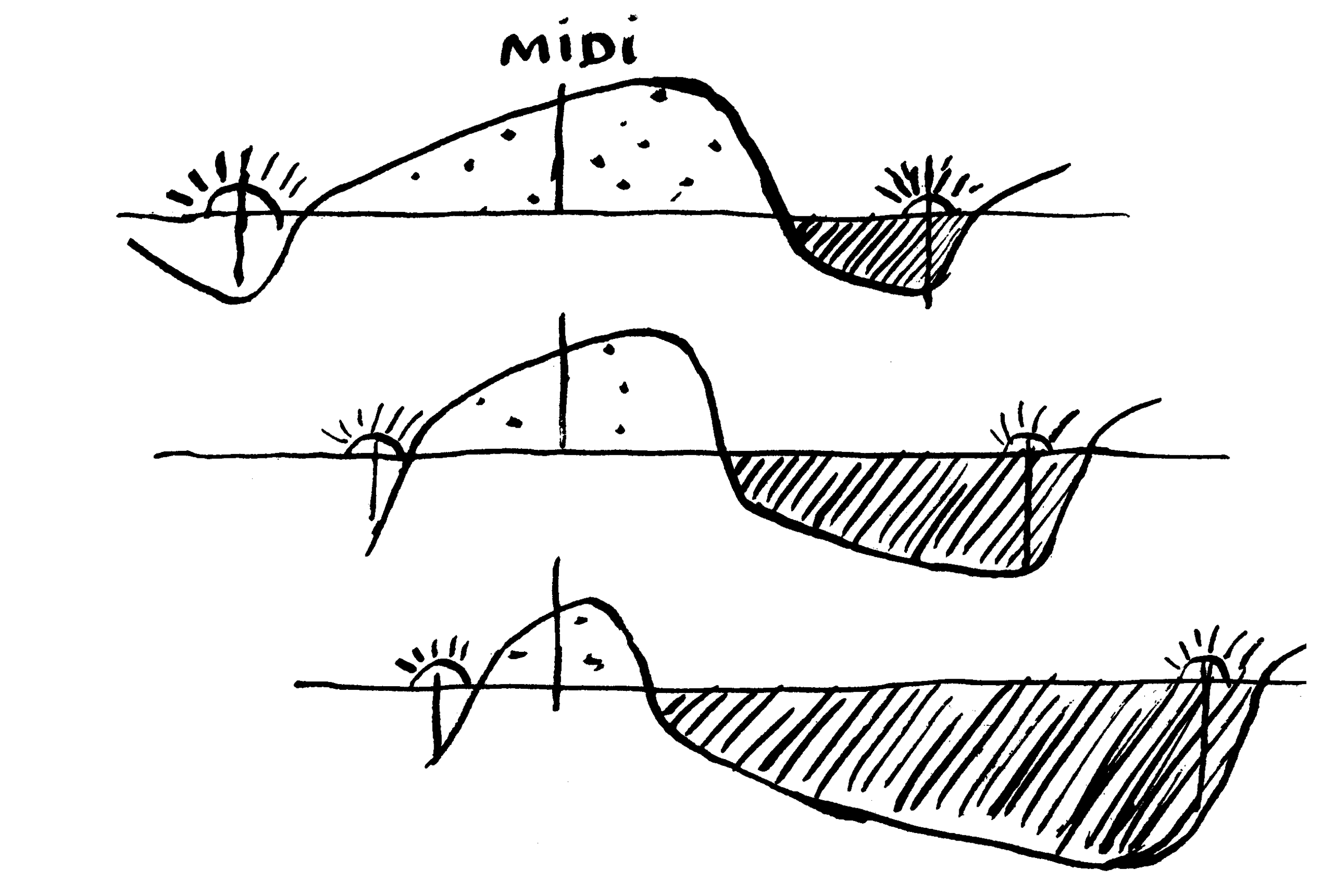
Le Corbusier worked to understand the rhythms of the sun in both poetic and scientific terms, culminating in Le Poeme de l’Angle Droit (The Poem of the Right Angle), created between 1947-53 and published in 1955.  It contains paintings with accompanying verses. 

Le Corbusier, from Le Poeme de l'Angle Droit (1955)

Le Corbusier, from Le Poeme de l'Angle Droit (1955)

The first painting (above) shows the path of the sun above and below the horizon.  It also resembles an engineer’s graph of heat gains and losses over the course of the day, with the horizon line being the zero line.

He published similar sketches as early as 1942 in La Maison des Hommes.  In this example, below, the shape is inflected to indicate the cumulative experience of solar heat being most profound in the late afternoon, and the progression from summer to winter.

http://formpig.com/blog/wp-content/uploads/2010/09/formpig_poeme-de-langle-droit-solar-II_corbusier.png

http://formpig.com/blog/wp-content/uploads/2010/09/formpig_poeme-de-langle-droit-solar-II_corbusier.png

When Le Corbusier formulated the Athens Charter for CIAM between 1933 and 1941, he encoded heliotherapeutic principles in the larger agenda of modern architecture and planning.  Here is article 26 of the Charter in full:

The most striking property of article 26—besides its polemical strength—may be its lateness.  This is a full generation after the ‘Davos-type’ sanatoria and Auguste Rollier’s publications La Cure de Soleil in 1914 and L’Heliotherapie in 1923, and a decade after the completion of the Zonnestraal sanatorium.  (The antibiotic cure for tuberculosis would be developed in 1946.)

In Le Corbusier's most strongly solar-oriented project, the Pavillion Suisse (Paris, 1930-31), he created a repetitive linear plan and oriented the long axis east-west, so that each room faced south.  A single-loaded interior corridor occupied the north side, and the narrow east and west walls were opaque.  This would later be understood as excellent practice for passive solar heating (but again he did not explicitly design for solar heat gain). Still, the building remains a valid case study for organizing rooms with respect to the sun, and avoiding the problem of the “thermal ghetto”.  It also included an early example of a responsive envelope: the south-facing glass curtain wall included motorized exterior roller-shades to provide control against overheating. 

Le Corbusier, Pavillion Suisse (Paris, 1933).  North is up.

Le Corbusier, Pavillion Suisse (Paris, 1933).  North is up.

Next he began to rework the famous cruciform skyscraper that populated his ideal city, Ville Radieuse.  He now realized the “heliothermic limitations” of the design, according to Kenneth Frampton.  By 1933, Le Corbusier discarded the cruciform and introduced a new “sun-inflected high-rise form,” where most of the spaces could face south.  Le Corbusier, as Frampton revealed, explained this design in a footnote in the Antwerp Plan:

“During these past few years, I have reworked the design of the crossplan skyscraper and evolved a more living form with the same static safety margin: a form dictated by sunlight.… There are no longer any offices facing north. And this new form is infinitely more full of life.”

But rather than continuing to explore these immensely interesting sun-responsive plans, he then worked through a decidedly negative experience with solar heat.  His Cité de Refuge for the Salvation Army (Paris, 1933), with its inoperable south-facing curtain wall, “proved disastrous in summer due to thermal gain.”  He was forced to retrofit the building with operable windows. 

After the disastrous Cité de Refuge, Le Corbusier focused his attention on shading. He drew his first two-dimensional shading diagram (for an Algiers office project) in 1938:

from Frampton, Le Corbusier , 2001.

from Frampton, Le Corbusier , 2001.

He “reluctantly accepted” the necessity of the brise-soleil, according to Paul Overy. 

Le Corbusier's experience was remarkably similar in substance, and uncannily parallel in time, to Fred Keck in America.  Each designed a glass project with tremendous overheating in 1933 and then dedicated subsequent years to understanding solar geometry and creating exterior shading devices.  Keck probably made the first 2D shading diagram just before Le Corbusier, in 1936 or 37.  And as I document fully in The Solar House, Keck turned his negative experience for good in designing solar-heated houses. 

In his future housing blocks, Le Corbusier avoided south-facing rooms.  The Unité d’Habitation at Marseille (1947-52) is, of course, well-noted for its sunny roof terrace and deeply shaded façades.  But perhaps less well-known is the building’s orientation.  The long axis runs north-south; the units, with their famous ‘double-orientation’, face east-and-west. 

Why did he orient the Unité in this manner?  One claim is that, in Marseilles, the north wind known as the mistral prompted him to orient the building with a small blank wall facing north.  But this does not explain the fact that Le Corbusier built four other Unité d’Habitation projects in different locations—Nantes-Rezé, Berlin, Briey, and Firminy—all oriented in the same manner.

In orienting the units east-west, he probably fell back on his memory of the orientation of German Zeilenbau housing projects of the 1920s, where east-west was seen as the ‘scientific optimum’ for heliotherapy, because east-facing bedrooms would receive sun in the mornings, and west-facing living rooms would have sunny afternoons.  (See Zeilenbau orientation and Heliotropic housing.)

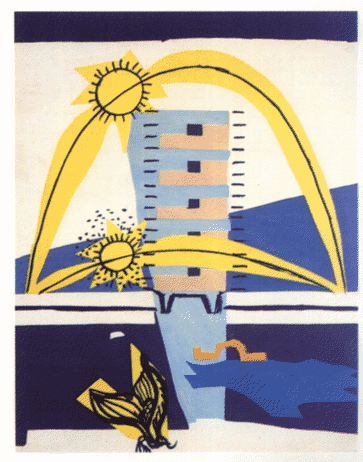
Moreover, in Le Poeme de l'Angle Droit, Le Corbusier painted a tall, narrow building overlaid with the tall parabolic path of the summer sun and the lower curve of winter.  The building clearly refers to the Unité d'Habitation, and the with east- and west-facing brises-soleil are enshrined as an intention.

Le Corbusier, from Le Poeme de l'Angle Droit (1955)

Le Corbusier, from Le Poeme de l'Angle Droit (1955)

The verse corresponding to this image reads, in part: 

L’horloge et le calendrier solaires ont apportés à l’architecture le “brise-soleil” installé devant les vitrages des édifices modernes.
Une symphonie architecturale s’apprête sous ce titre: “La Maison Fille de Soleil”

“The clock and the solar calendar brought to architecture the “brise-soleil” to be installed in front of the windows of modern buildings.
An architectural symphony is prepared under the title: ‘The House, Daughter of the Sun’.”

The curious phrase “La Maison Fille de Soleil,” later appeared as the title of an obscure Don Cherry jazz LP, with original (?) artwork by Le Corbusier.  More info and hi-res images here.  I am hesitant to interpret the astonishing unfolded image at that link, but it seems to be an exhibition of Le Corbusier's work, including the last image above, inside a grand Baroque suite of rooms. 


Sources:
Kenneth Frampton, Le Corbusier, 2001.
Richard Hobday, The Light Revolution: Health Architecture and the Sun, 2006.
Paul Overy, Light, Air and Openness: Modern Architecture Between the Wars, 2007.

See also:
Le Poeme de l'Angle Droit at Fondation Le Corbusier
”Le Corbusier in the Sun,” Architectural Review, February 1993.

More recently on the blog:
Speculative Redesign: Unité d'Habitation

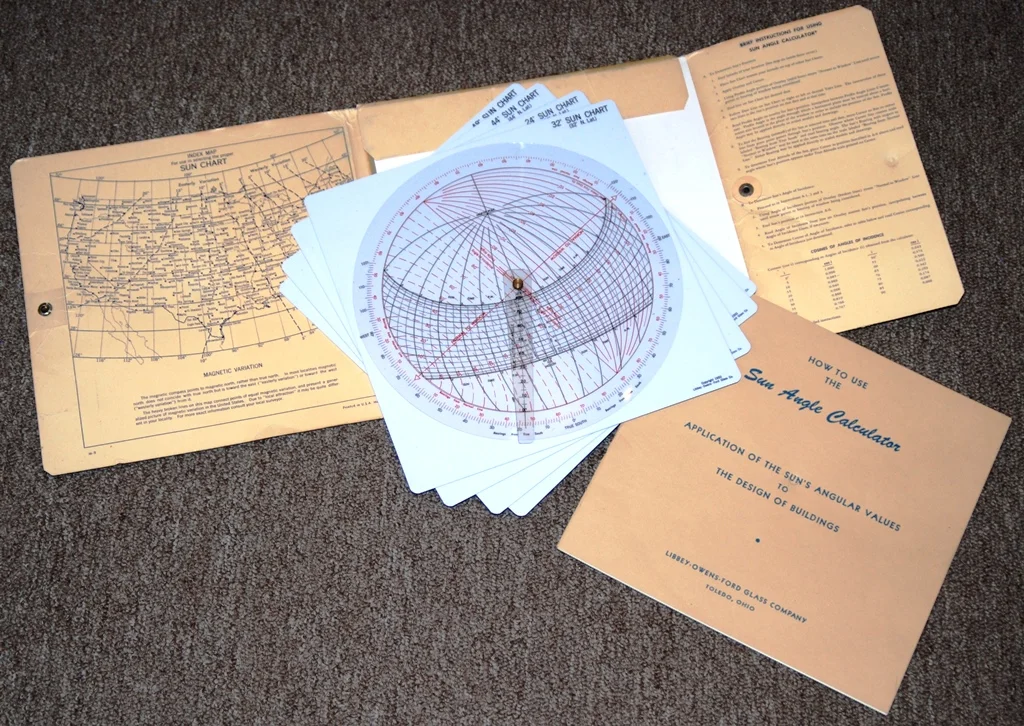
Tools: Libbey-Owens-Ford's Sun Angle Calculator

With all of the technological sophistication available today, it's fascinating to think about the tools and data available to early solar architects.  Previously I discussed Whit Smith's solar tool , a homemade device using solar cotangent diagrams published in 1938.

The first commercially-available solar tool (that I am aware of) was made by the Libbey-Owens-Ford glass company beginning in 1951.  I recently purchased one as a gift for a friend, and took a few pictures before sending it along.

L-O-F calculator (3).jpg
L-O-F calculator (1).jpg

Earlier, in 1946, Libbey-Owens-Ford had patented a slide-rule type of device: "Method and Apparatus for use in Designing Solar Houses".   It was never produced as far as I can tell.